Monohull vs Catamaran: Which Should You Charter?
Updated
Monohull or catamaran — the choice depends on whether you want to sail the boat or live on it. This guide breaks down the real tradeoffs, costs, and profiles to help you charter the right boat for your crew.
On this page

Every year, thousands of sailors sit down with a charter broker and face the same question: monohull or catamaran? The internet mostly tells you catamarans have more space and monohulls are "real sailing." Both statements are true, and neither one is the whole story.
This guide is for the person who already knows they want to charter — and wants to think clearly about which type of boat actually fits their trip. We'll cover who each boat suits, what the tradeoffs genuinely look like, and what the experience on the water will feel like day to day. We'll also be honest about the elephant in the room: most charter catamarans are floating vacation apartments that happen to have sails. That's not an insult. For many people, that's exactly what they want. But it's worth knowing before you book.
Who Is Asking This Question?
Before comparing boats, it helps to be honest about who you are and what you're actually trying to get out of the week. The right answer changes completely depending on your answer to these questions:
Crew size: Two people? Six people? A family with kids under 12?
Sailing experience: Are you trying to improve, or do you sail year-round and just want a holiday?
Comfort expectations: Does a sloped cabin sole at night ruin your sleep, or do you not notice it?
Budget: Weekly charter rates for catamarans are typically 40–80% higher than comparable monohulls. That gap matters.
Destination: Shallow anchorages in the Bahamas? Deep-water marinas in Croatia? The boat's draft becomes a real factor.
The goal: Do you want to sail the boat or live on the boat? There is a meaningful difference, and choosing the wrong type will leave you frustrated either way.
The Boats: What You're Actually Choosing Between
Charter Monohull (36–50 ft)
A performance-oriented charter monohull — think Beneteau Oceanis 46.1, Jeanneau Sun Odyssey 440, or Bavaria C45 — gives you a genuinely responsive sailing experience. These boats heel, they react to the wind, and if you trim the sails properly, you feel it. The newer generation of monohulls has grown beamier and more comfort-focused than their predecessors: double-berth aft cabins are now standard, saloons are bright, and heads are no longer an afterthought. That said, the cabins are narrower than a catamaran, the galley is smaller, and when you're at anchor in a swell, you'll feel the roll. Night passages on a monohull require adjustment — anything left loose will slide. For a couple or a small crew of four who actually want to sail, a 40–45 ft monohull is probably the sweet spot of space, performance, and affordability. The downsides: sleeping comfortably in a marina berth in 30°C heat with six adults aboard is not pleasant, the single cockpit concentrates everyone into one social space (good or bad depending on your crew), and the leeward berths at sea are caves. But the boat rewards good sailing decisions and punishes lazy ones — which is exactly what some people are looking for.
Charter Catamaran (40–50 ft)
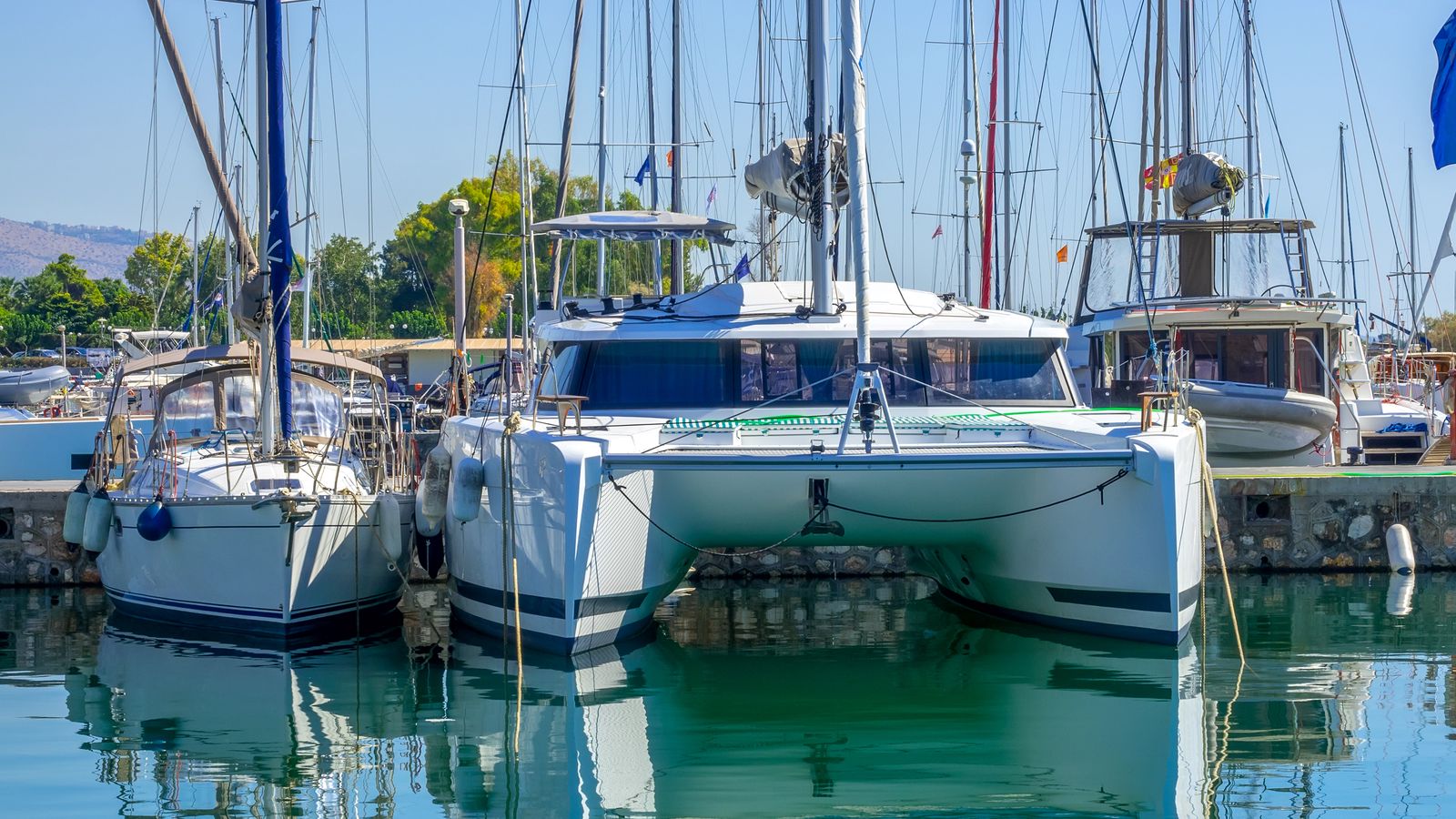
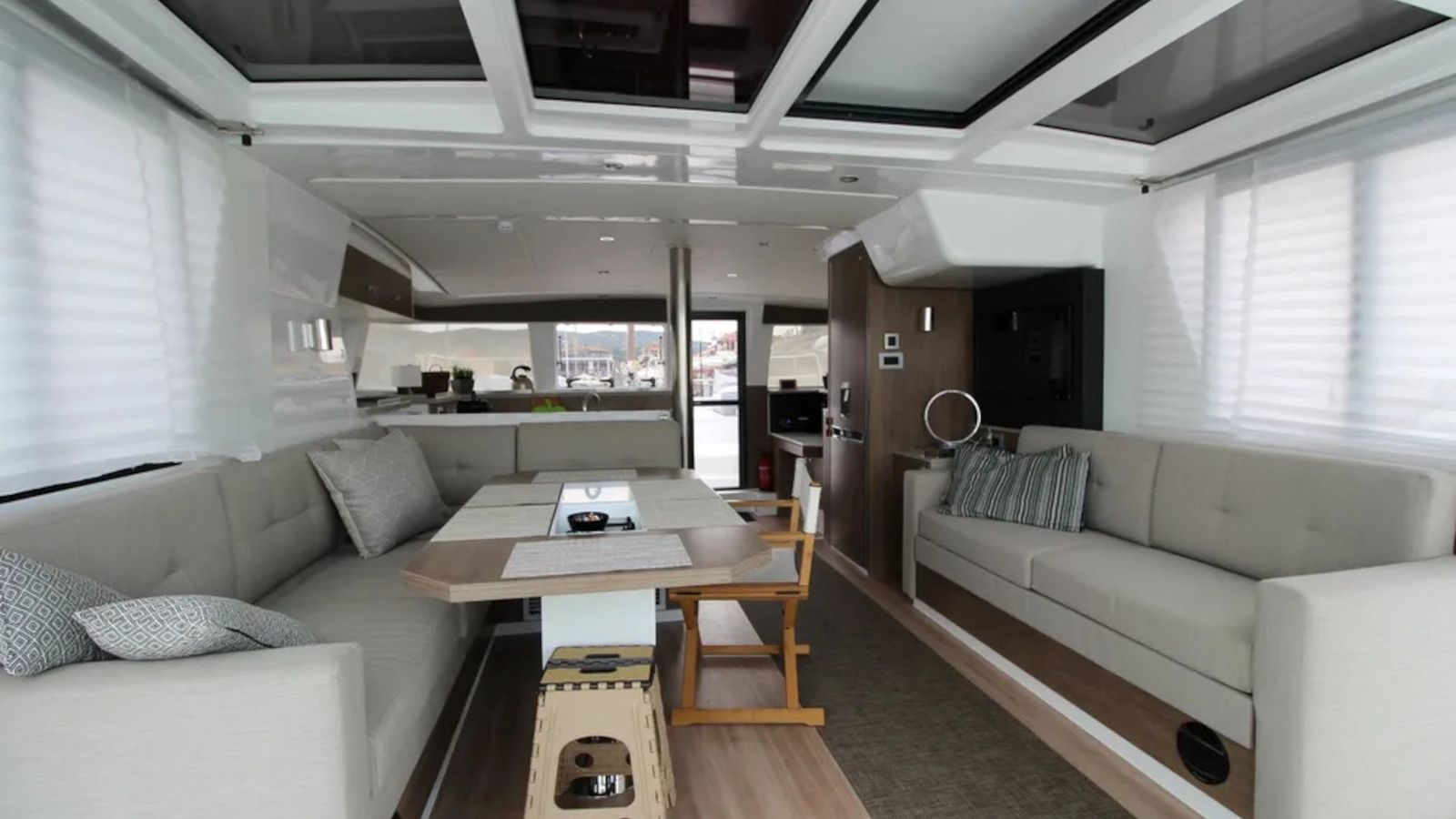
A typical charter catamaran — Leopard 45, Fountaine Pajot Elba 45, Lagoon 46 — is built to maximise accommodation and deck space within the EU and Caribbean bareboat market. The result is extraordinary living comfort and a sailing experience that is, by design, secondary. The flat platform at anchor is the killer feature for families with children and for anyone who gets seasick on a heeling monohull. The saloon is enormous, the cockpit is shaded and social, and the hulls each hold a cabin-and-head combination that gives couples genuine privacy. There are real downsides that charter brochures gloss over. First, the sailing: the high, boxy superstructure creates enormous windage, and the wide beam means the apparent wind changes slowly when you tack. Charter cats are routinely undercanvassed for the displacement they carry. Most crews end up motor-sailing or motoring more than they expected — not because they're lazy, but because the boat simply doesn't perform well below about 12 knots of wind unless you're on a beam reach. Second, marina berths: a 45 ft cat needs a berth sized for a 65 ft monohull. In Croatia, Greece, and Spain this means either expensive marina fees or anchoring out every night — which on a cat, thanks to the shallow draft and large flat deck, is often the better option anyway. Third, price: you will pay significantly more per week for a cat than for a monohull of nominally similar length, and the gap is not closing.
Performance Monohull or Racing-Oriented Charter (38–45 ft)
A smaller number of charter fleets — particularly in the Mediterranean and the UK — offer more sailing-focused boats: Dehler 38, Dufour 390, or older Oyster and X-Yacht models. These are for experienced sailors who find the idea of a floating hotel depressing. The compromise is real: fewer berths, a smaller galley, a narrower beam, and charter companies that may require stronger qualifications to take one out. But the reward is a boat that sails properly — that responds to sail trim, points well, and makes a beat upwind feel like actual sailing rather than a car ferry. If you're doing a week in Scotland, Brittany, or the Adriatic with an experienced crew of two to four and the sailing itself is the objective, this is the category to look at. The downsides are that comfort is modest by modern standards, prices don't drop as dramatically as you'd hope relative to standard charter monohulls, and availability is genuinely limited.
Tradeoffs at a Glance
FactorStandard Charter Monohull (42–46 ft)Performance Monohull (38–44 ft)Charter Catamaran (44–48 ft)Typical berths3–4 cabins, 6–8 berths2–3 cabins, 4–6 berths4 cabins, 8 berths (2 per hull)Draft1.8–2.1 m1.9–2.3 m1.0–1.3 m (excellent for shoal water)Stability at anchorRolls in swellRolls in swellFlat — very stableSailing performanceGoodVery good to excellentModerate — best on a reach in 12+ knotsManoeuvring difficultyModerateModerate to demandingHigh — wide beam, prop walk from two enginesMarina berth costStandardStandardHigher (billed by beam, not length)Weekly price tier (bare)€2,500–€5,000€2,000–€4,000€4,500–€9,000+Typical qualification requiredRYA Day Skipper / ICC equivalentRYA Coastal Skipper or aboveRYA Day Skipper / ICC + cat endorsement (some operators)Fuel consumption4–6 L/hr motoring3–5 L/hr motoring8–14 L/hr motoring (two engines)Best destination fitCroatia, Greece, Med, BVIAtlantic Arc, UK, BrittanyBVI, Bahamas, Grenadines, downwind Med routes
Recommendation by Crew Profile
🧭 First-Time Charterers — Couple or Small Group of Four
Charter a monohull, 40–44 ft. You have enough space for the crew, you'll be manageable in a marina, and you'll spend significantly less money. You don't yet know whether you'd actually use or enjoy a catamaran's space, and the price difference is not trivial. A Beneteau Oceanis 41.1 or Jeanneau Sun Odyssey 410 is the rational choice. Consider hiring a skipper for at least the first day or two if your qualifier certificate is brand new.
👨👩👧👦 Family of Four or Five with Children Under 12
Catamaran, 44–46 ft minimum. The flat deck at anchor is genuinely important for children — the risk of a falling child on a heeling monohull at sea is real and exhausting to manage. The stable platform also means adults sleep better, cooking is easier, and the kids have actual space to play. The extra cost is worth it for the reduction in stress. A Leopard 45 or Lagoon 42 are common choices; the Fountaine Pajot Elba 45 is newer and very family-friendly. Accept that you will mostly motor-sail and plan your week accordingly with downwind or reaching routes where possible.
🍺 Six Friends on a Budget Who Want to Party and Explore
Monohull, 45–50 ft. Six adults on a cat sounds great until you look at the price. A 47–50 ft monohull like a Dufour 48 or Beneteau Oceanis 51.1 will fit your crew, costs substantially less per week, and honestly a six-adult sailing trip is about the evenings in port as much as the sailing anyway. The cockpit will be crowded, the aft cabins will be warm, and someone will end up in the forward cabin that smells faintly of sail — but you'll be fine. Split the cost six ways and you'll have money left for the restaurant bills.
⛵ Experienced Sailor Who Actually Wants to Sail
Performance monohull, 38–44 ft, smallest competent crew. If you're a qualified offshore sailor taking a week in the Aegean or Brittany or the Azores and you want the boat to respond properly, look for a fleet offering Dehlers, X-Yachts, or similar. Go with two to four people maximum. Accept that the accommodation is modest, that you'll be trimming sails while your friends are sipping rosé on a cat three bays over, and that you will not care. This is the boat for people who find motor-sailing an affront.
🌴 Couple Who Wants Luxury and Isn't Really Interested in Sailing
Catamaran, 45 ft+, or skip bareboat entirely and consider a crewed charter. Honest answer: if you want the catamaran lifestyle — big saloon, private hull each, flat platform, anchoring in remote bays — but the sailing is not the point, a crewed catamaran or a skippered bareboat will be far more enjoyable than struggling with a boat that you find intimidating. There is no shame in this. A crewed week on a 50 ft cat in the BVI or Grenadines is genuinely wonderful and takes away all the operational stress.

Cost Reality
Charter brochures quote the base weekly rate and nothing else. Here is what your budget actually needs to cover:
Base charter fee: €2,500–€5,000 for a standard monohull; €4,500–€9,000+ for a catamaran (Caribbean and peak Med season push higher)
Security deposit: Typically €2,000–€5,000 held on a credit card at handover. Reducible with charter excess insurance (around €200–€400/week — buy it)
Fuel: Budget €150–€400 per week on a monohull; €300–€700 on a catamaran depending on how much you motor and where diesel is priced
Marina fees: In Greece and Croatia, popular harbours charge €60–€150/night for a 45 ft monohull. A catamaran will pay 20–50% more. Anchoring out eliminates this but isn't always possible
Provisioning: A reasonable estimate is €60–€90 per person per day for food and drinks aboard, less if you provision from supermarkets rather than marinas
End-of-voyage cleaning fee: Often €150–€300 if charged separately — check your contract
Skipper (if required): €150–€250/day plus food and a crew berth. Some operators require a local skipper for certain destinations regardless of your qualifications
A realistic all-in week for four people on a monohull in the Med in peak season: €6,000–€9,000 total. On a catamaran: €10,000–€16,000. Per person the gap shrinks as crew size increases, but the catamaran premium is real.
Licensing and Qualifications
Charter operators in most countries accept the RYA Day Skipper (or equivalent ICC-endorsed certificate) for standard charter monohulls up to around 45–50 ft. The Coastal Skipper or offshore qualification is increasingly expected for performance boats or destinations with more exposed passages.
For catamarans, a growing number of operators — particularly in the Caribbean — require either a catamaran endorsement from your qualifying authority, or a short checkout sail with a base instructor before you take the boat. This is sensible: a 46 ft catamaran with 7 m of beam handles very differently from a monohull in a marina, and the consequences of getting it wrong are expensive. Budget for one or two hours of briefing time at base and take it seriously.
Country-specific rules vary: Greece requires a Sailing Licence or IOTP certificate for chartering in territorial waters. Croatia has accepted the ICC since 2020. The BVI requires proof of sailing experience logged in your logbook regardless of certificate. Always verify current local requirements with your charter company — these rules change and a broker's knowledge may be a year out of date.
If your certificate is theoretical only — you passed the Day Skipper theory but haven't completed the practical — hire a skipper. Not as a luxury, as a safety decision.
Handover Checklist: What to Inspect Before You Leave the Dock
Whatever boat you charter, your handover with the base technician is your last chance to document the boat's condition and confirm everything works. This process typically takes 1–2 hours and should not be rushed.
Sails and Rig
Check mainsail, headsail (and code zero or gennaker if fitted) for tears, UV damage, and batten condition
Run the furling systems both ways before signing off
Check standing rigging for broken strands at the chainplates and spreaders
Test the traveller, mainsheet, and kicker/vang
Engines and Electrics
Start the engine(s) at the dock and check for unusual noise or smoke
Confirm battery bank state and charging (engine, solar, shorepower)
Test the windlass under load if possible — anchor failures are inconvenient
Check fuel levels against the gauge and confirm diesel quality (ask when it was last filled)
Navigation Electronics
Power on the chartplotter and confirm the chart card covers your sailing area
Check AIS (transmit and receive), VHF DSC function, and autopilot
Test depth sounder and log — not just that they show a number, but a plausible one
Safety Equipment
Locate and inspect life jackets — one per person, correct size, auto-inflation indicators green
Find and check the life raft (service date current), EPIRB (registration current and battery valid), flares (in date)
Check fire extinguishers — pressure gauge in green, pin and seal intact
Test bilge pump, both manual and electric
Dinghy and Outboard
Inflate the dinghy fully and check for slow leaks — do this at handover, not at anchor two miles from shore
Start the outboard motor. If it won't start at the dock, it won't start later
Confirm fuel for the outboard is aboard and a spare prop is available
Document Everything
Photograph any existing damage — gelcoat chips, winch scratches, torn upholstery — before you move the boat
Email or WhatsApp your photos to the base immediately so they are timestamped
Confirm the procedure for reporting damage or emergencies 24/7
The Honest Answer
If you want to sail, charter a monohull. If you want to live on the water for a week and the sailing is incidental, a catamaran will make that week more comfortable. If you have children under 10, the catamaran's stability justifies the price premium. If you're budget-constrained, a monohull almost always wins on value. If you're genuinely experienced and care about the quality of the sailing, look past both standard charter categories and find a fleet offering proper performance boats.
The worst outcome is booking a catamaran because you imagined the sailing and discovering it mostly motors, or booking a monohull because it was cheaper and spending the week miserable in a rolling swell with six people who didn't sign up for this. Both mistakes are avoidable. Be honest about what you actually want, and the choice becomes straightforward.


