How to Provision a Charter Boat: A Week of Meals Without the Stress
Updated
A practical first-timer's guide to provisioning a charter yacht for a week: how much water to buy, how to plan simple meals, and what to expect in popular charter bases like Split, Lefkada, and Palma.
On this page

Provisioning a charter boat is one of those tasks that sounds simple until you're standing in a foreign supermarket with a shopping cart, a phrasebook, and seven hungry crew members waiting at the marina. Get it right and you'll glide through the week with full bellies, cold drinks, and minimal stress. Get it wrong and you'll be making a sunburnt sprint to a remote island mini-market that closes at noon.
This guide walks you through how to plan a week's worth of meals on a charter yacht, what to buy before boarding versus en route, and how to handle provisioning in popular bases like Split, Lefkada, and Palma. It's written for first-timers, but even seasoned sailors might pick up a tip or two.
Start With the Basics: Water, Power, and Storage
Before you even think about menus, understand the constraints of your floating kitchen. These three factors shape every decision you'll make.
Water Is Non-Negotiable
Here's something most first-timers underestimate: never trust the water from the boat's tanks for drinking. Charter boat water tanks are rarely cleaned thoroughly between charters, and even when the water is technically potable, it often tastes of plastic or chlorine. Use tank water for showering, dishes, and brushing teeth, but buy bottled water for everything you'll actually drink or cook with.
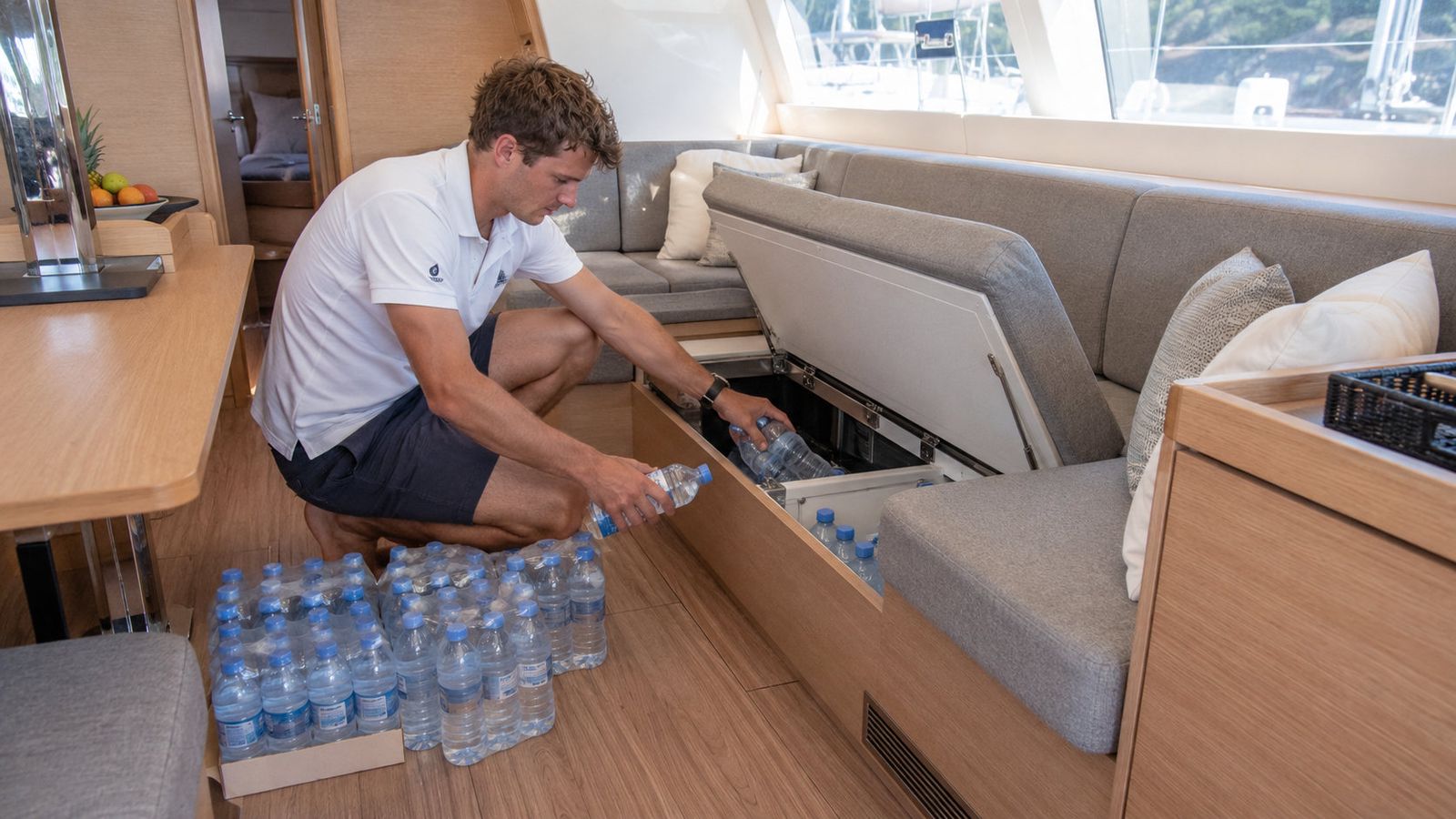
A reliable rule of thumb: 3 liters of bottled water per person per day. For a crew of six on a one-week charter, that's around 100 liters. Buy it all on day one. Bottled water is cheap in most charter destinations, and even if you over-buy by 20 or 30 liters, the hit to your budget is negligible. The storage lockers under the saloon benches are perfect for stashing cases of water.
Fridges and Freezers Are Not Like Home
Unless you're on a brand-new boat, the onboard fridge will be less efficient and hungrier for battery power than what you're used to. Many charter boats have top-opening fridges, which means every time you reach for the yogurt, you have to dig past everything stacked on top of it. Two tricks help enormously:
Tetris skills. Pack the fridge tightly. A full fridge holds cold better than a half-empty one. Put items you'll need first on top and bury the rest.
Buy a big bag of ice on day one. Tucked into the fridge or freezer, ice keeps temperatures down and reduces how hard the compressor has to work. That saves battery, which matters a lot if you're anchoring out instead of plugging into shore power.
Don't plan meals that depend on freezing fresh meat for five days. Assume the freezer is more of a "cool box" and shop accordingly.
Planning the Week's Meals
The classic charter rhythm looks like this: breakfast and lunch on board, dinner ashore every other night. That gives you about 7 breakfasts, 7 lunches, and 3 to 4 dinners to plan for. Build your shopping list around that rhythm rather than trying to cater for 21 full meals.
Breakfast: Keep It Easy
Mornings on a boat are slow and pleasant. People wake up at different times, so go for grab-and-graze options:
Bread, butter, jam, and a local cheese or two
Yogurt, granola, and fresh fruit
Eggs (they keep unrefrigerated for over a week if they haven't been refrigerated already, common in Mediterranean countries)
Coffee, tea, juice, and milk (UHT/long-life milk is your friend)
Lunch: Simple, Simple, Simple
This is where new charterers most often go wrong. After a morning of sailing, the crew is ravenous, but anyone trying to cook a hot meal in a rocking galley quickly discovers the joy of seasickness. Plan lunches that need almost no work:
Sandwiches and wraps with cured meats, cheese, tomato, and cucumber
Salads: Greek salad, tuna and white bean, pasta salad made the night before
Pasta or rice with a pre-cooked sauce if conditions are calm and you're at anchor
Cold platters: olives, hummus, bread, prosciutto, melon
The golden rule: the less time someone has to spend below deck while underway, the happier their stomach will be.
Snacks Matter More Than You Think
Sailing burns calories, swimming burns calories, and salty air seems to burn calories on its own. Stock up on snacks: nuts, crackers, dried fruit, chocolate, biscuits, fresh fruit. Mid-afternoon snack breaks are one of the small joys of charter life, especially when shared in the cockpit at anchor.
Dinners On Board
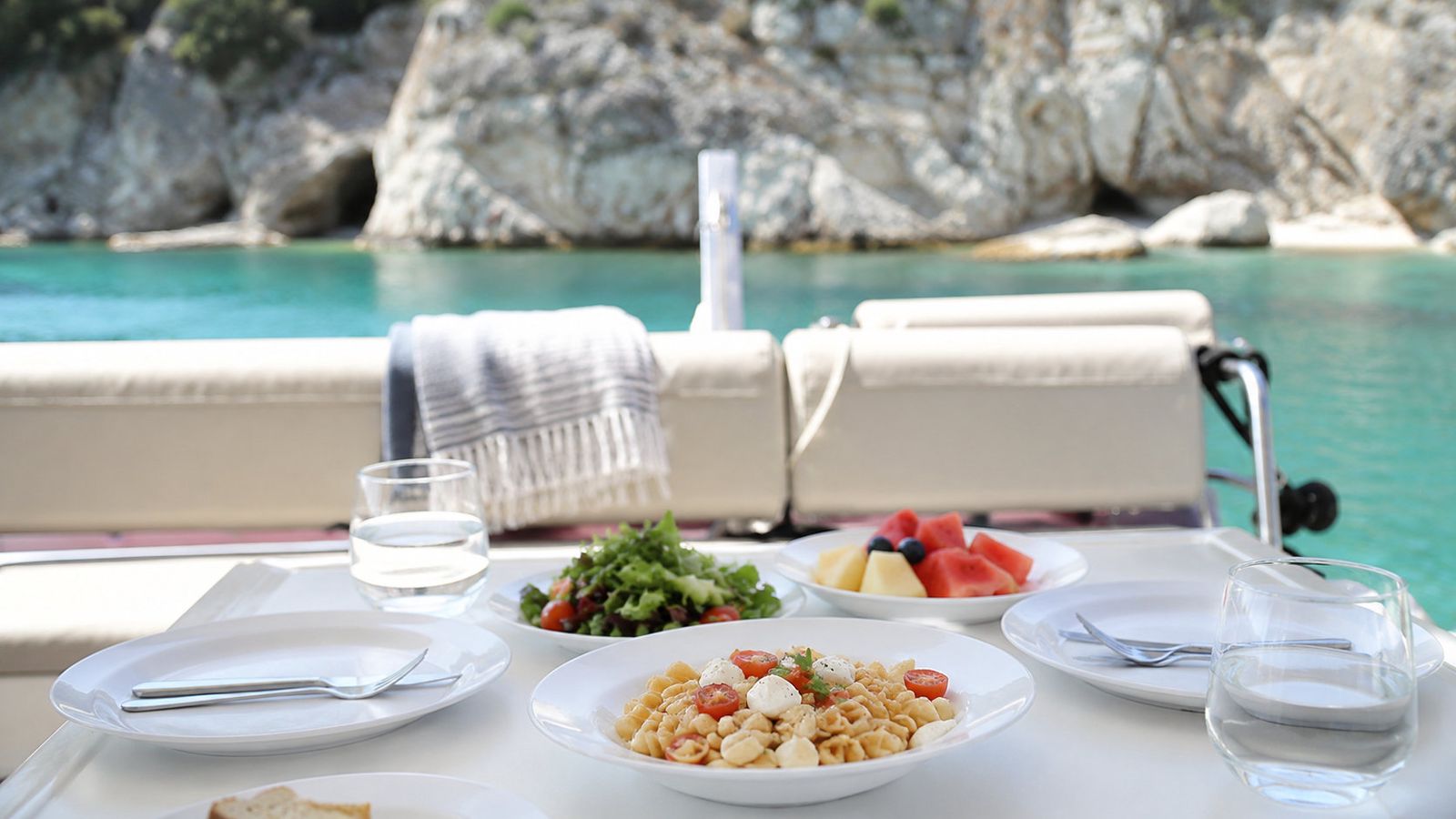
For the nights you eat aboard, choose one-pot meals that work in a small galley:
Pasta with tomato sauce, garlic, and local sausage
Risotto with whatever vegetables and seafood you found at the market
Grilled fish or chicken if your boat has a stern barbecue
Stir-fry with rice
Before Boarding vs En Route: What to Buy When
Most charterers do one big shop on day one, near the base, and then top up at small markets during the week. Here's how to split it.
The Big Day-One Shop
Do this immediately after the boat handover, before you leave the marina. Buy:
All your bottled water for the week
All shelf-stable items: pasta, rice, oil, vinegar, sauces, coffee, tea, UHT milk
Long-life proteins: cured meats, hard cheeses, canned tuna, eggs
Wine, beer, and spirits (much cheaper at supermarkets than at island bars)
Cleaning supplies (more on these below)
Snacks and breakfast staples
Enough fresh produce for the first 3 days
Topping Up En Route
Buy fresh bread, fruit, vegetables, and seafood at the small harbors and villages you visit. This is half the fun of charter cruising: wandering into a Croatian konoba or a Greek bakery and discovering what's local and in season. Just don't rely on it for staples. Many island shops are tiny, expensive, close for long lunch breaks, and may be shut entirely on Sundays or off-season.
Don't Forget the Non-Food Essentials
Charter companies vary wildly in what they include. Some hand you a starter kit; others give you nothing but the keys. Always check, and assume you'll need to buy:
Toilet paper. The one roll they leave is never enough.
Dish soap and sponges
Hand soap
Surface cleaner or wipes for the galley
Paper towels
Trash bags
Sunscreen (more expensive on board than you'd believe if you forget it)
Provisioning in Popular Charter Bases
Split, Croatia
Split has excellent supermarket options close to the main charter bases (ACI Marina Split, Marina Kaštela, Marina Trogir). The big chains, Tommy, Konzum, and Lidl, all have stores within a short taxi ride. Lidl tends to be the cheapest. Many bases offer a free or low-cost shuttle to a nearby supermarket on turnover day. There's also a green market (pazar) in central Split with superb fresh produce, fish, and olive oil if you have time before boarding.
Lefkada, Greece
Lefkada town has a Lidl and an AB supermarket, both within easy reach of Lefkas Marina. Stock up well here, because once you head south through the Ionian, supplies on smaller islands like Meganisi, Kalamos, and Kastos are limited and pricier. The town market has fantastic fruit, tomatoes, and feta. Local bakeries are a daily must.
Palma de Mallorca, Spain
Palma is a provisioning paradise. Mercadona, Carrefour, and Eroski all have large stores, and several offer online ordering with delivery directly to your boat at marinas like STP, La Lonja, or Naviera Balear. If you're chartering during peak summer, pre-order a few days before your arrival to skip the day-one supermarket dash entirely. Mercat de l'Olivar is the city's central market and an experience worth having for fresh seafood, jamón, and produce.

Quick Tips to Save Stress
Make a list before you fly. Plan rough meals for the week and write the shopping list at home. Standing in a foreign supermarket trying to remember if you wanted basil or oregano is no fun.
Assign one person as provisioning lead. Decisions by committee in a supermarket take three times as long.
Buy more bread than you think you need on day one, then top up fresh as you go.
Label your wine and beer. Warm beer in the bilge gets forgotten. A quick inventory list taped inside a locker helps.
Keep a "running low" list on the nav table. When something gets low, write it down so the next person ashore can grab it.
Don't over-cater. First-timers always buy too much food and not enough water. Aim for the opposite.
Summary
Provisioning a charter boat for a week comes down to four principles: buy plenty of bottled water on day one and never drink from the tanks; work with the limitations of a small fridge by packing it tight and using ice; plan simple breakfasts and lunches that don't require cooking underway; and remember the boring essentials like toilet paper and dish soap that the charter company probably won't provide.
Do one big shop near the base on day one, then top up with fresh bread, produce, and local discoveries as you cruise. With a little planning, provisioning becomes part of the adventure rather than a stressful chore, and you'll spend the week eating well, sleeping well, and enjoying exactly the kind of holiday you came for.


