Family Sailing Charters: How to Plan a Safe and Fun Boat Holiday with Young Children
Updated
Sailing with babies and toddlers is not as daunting as it sounds — thousands of families do it every summer and come home planning the next one. The secret is picking the right boat, the right sea, and knowing which safety gear to insist on before you leave the dock.
On this page

Taking young children sailing for the first time is one of the most rewarding things a family can do together — and one of the most anxiety-inducing things a parent can plan. The good news is that thousands of families charter boats in the Mediterranean every summer with children as young as six months old, and they come home wanting to do it again immediately.
This guide covers everything you need to know: how to choose the right boat, which sailing areas are genuinely safe for little ones, what safety gear to insist on (including the often-overlooked jackline netting that keeps babies and toddlers aboard), and how to structure your days so that everyone — from the five-year-old to the grandparents — actually has fun.
Why a Sailing Charter Is Actually Great for Families
The standard objection goes something like this: "But what if the kids hate it?" The counter-argument is that a sailing charter is, in many ways, the perfect family holiday format. You unpack once and your hotel follows you from island to island. Every morning you can anchor off a deserted beach that the day-trippers cannot reach. The cockpit becomes a giant play area. The sea is always right there for swimming. And children who are bored on land are almost never bored on a boat — there is simply too much going on.
The key is matching the destination and boat type to your family's experience level and the ages of your youngest crew members. Get that right, and the rest follows naturally.
Choosing the Right Boat for Families with Young Children
Catamarans versus monohulls
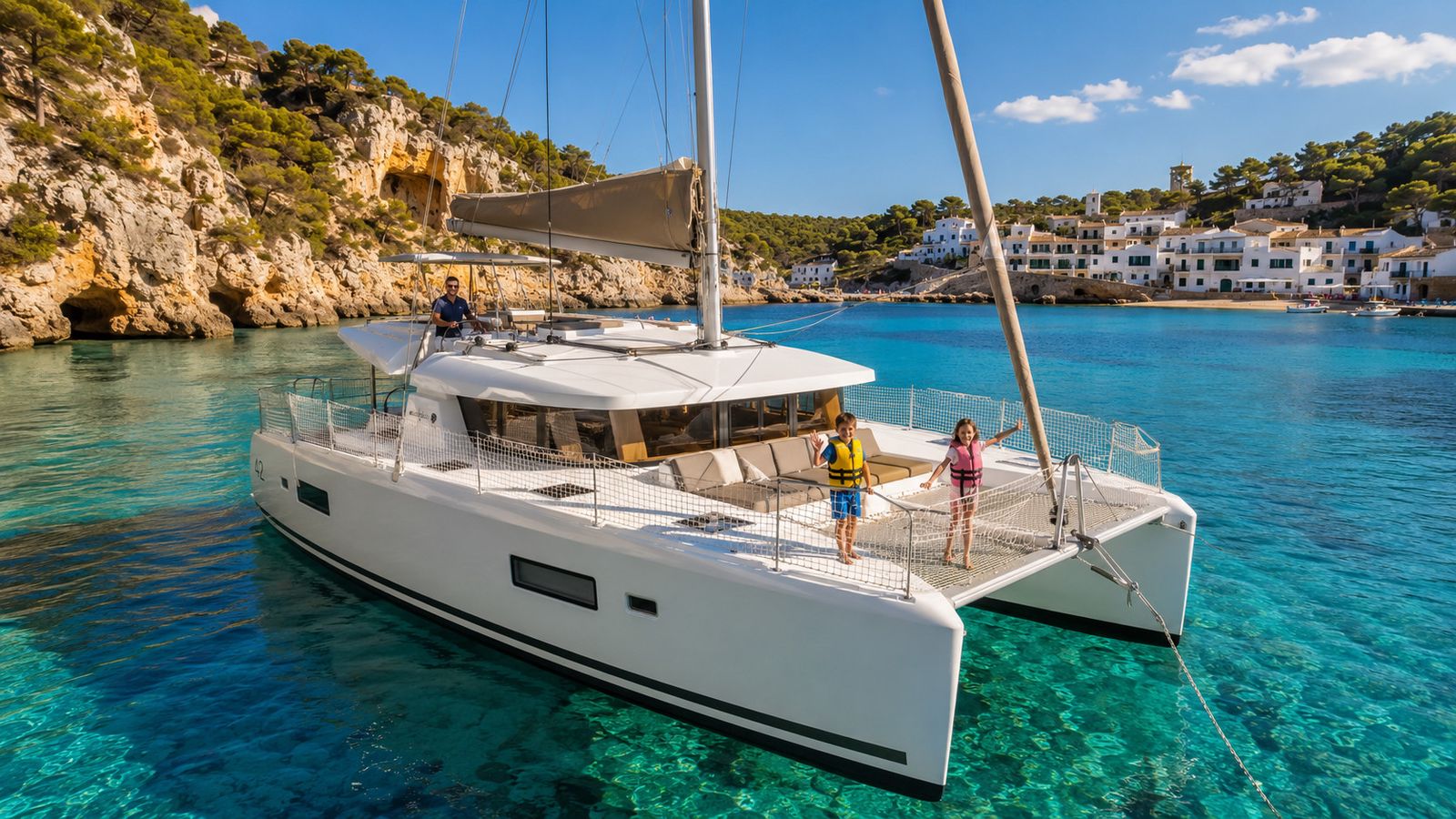
For most families with children under ten, a catamaran is the smarter choice. The reasons are practical rather than romantic. Catamarans heel far less than monohulls, which means toddlers can walk around the deck without constantly falling into an adult's arms. The wide beam creates an enormous cockpit — often large enough to set up a small paddling pool, lay out toys, and still have adults seated comfortably. The trampoline netting between the hulls doubles as a shaded play area at anchor. Seasickness is also less common on cats because the motion is a gentle pitch rather than the rolling lurch of a monohull in a chop.
Monohulls are not off the table, especially for families where one or both adults already sail and the children are old enough to understand "hold on" commands. A 40-foot monohull with a large cockpit and good guardrails can work beautifully. But if you are chartering for the first time with a baby or a toddler, start with a catamaran.
Size matters more than you think
Go bigger than you think you need. A family of four adults and two small children should be looking at a minimum of 42–44 feet on a catamaran. You need space to set up a travel cot, to store a pram dinghy (if you bring one), to separate sleeping areas so early-rising children don't wake everyone at 5 a.m., and to spread out during a rare rainy afternoon. The cost difference between a 38-footer and a 44-footer is often less than the difference between a holiday everyone remembers fondly and one that frays nerves.
Cockpit layout
When reviewing charter listings, look specifically at cockpit photographs. You want a cockpit with a table at centre, high coaming (the raised surround) on all sides, a stern platform that is stepped rather than a sheer drop, and easy access to the swim ladder. Avoid boats with wide open transoms at toddler height unless you plan to rig netting across the gap — which we will come to shortly.
The Safety Net That Could Save Your Child's Life
This is the section that most family sailing guides gloss over, and it should not. Falls overboard are rare in charter sailing, but the risk is disproportionately concentrated in one group: children under five who are fast, unpredictable, and not yet able to swim to safety if they go in the water.
What jackline netting (lifeline netting) is
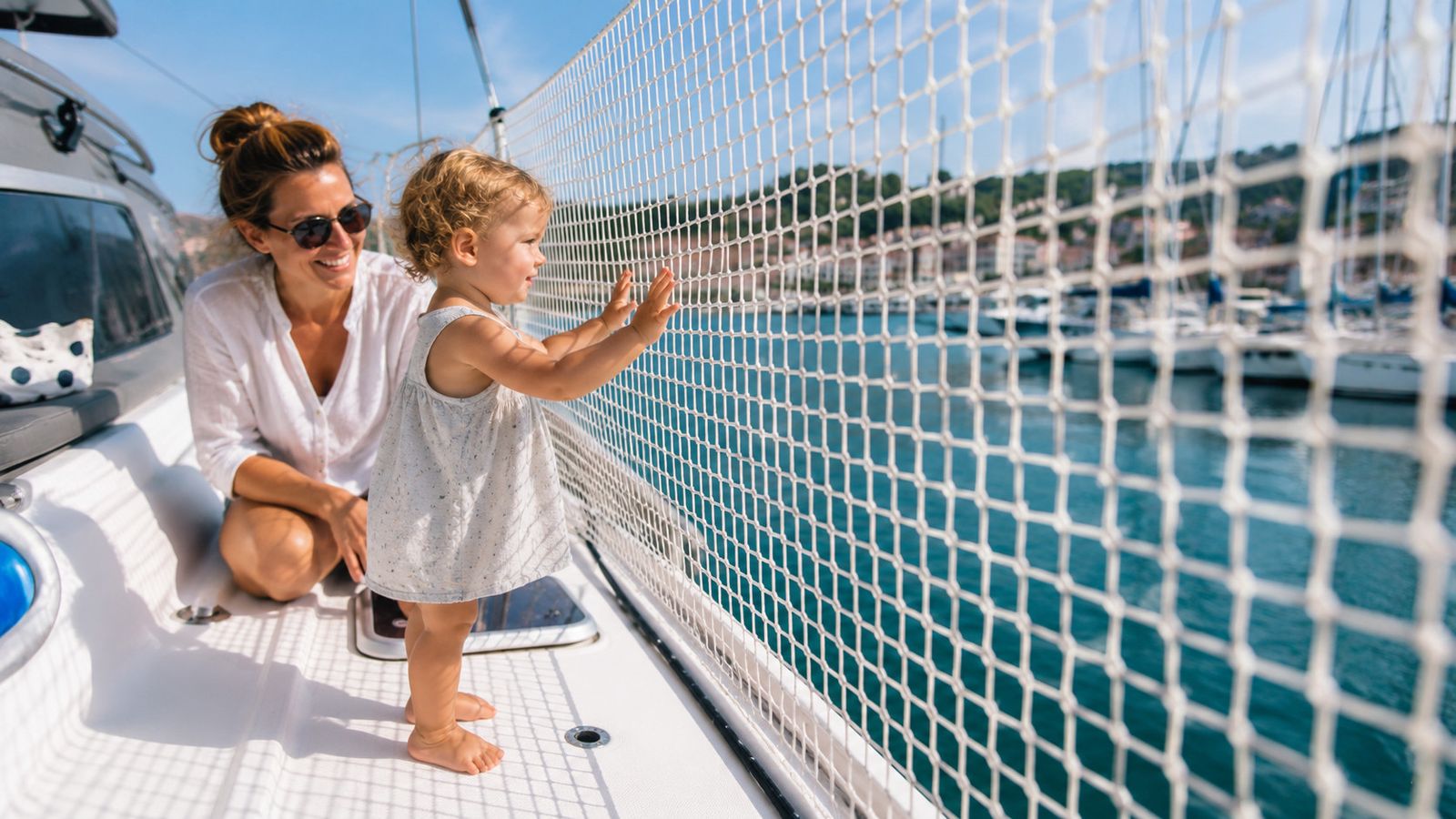
Standard sailing vessels have stanchions and jacklines (also called lifelines) running around the deck — a metal rail or wire at roughly knee height. For an adult, this is a meaningful deterrent. For a child under three, it is completely ineffective: they can roll under it, slip through the gap between the lower lifeline and the toe rail, or simply topple over it.
Lifeline netting — sometimes called baby netting, safety netting, or guardrail netting — is a fine-mesh net that laces vertically between the lower lifeline and the toe rail and between the lower and upper lifelines. It creates a solid barrier around the entire perimeter of the deck and cockpit, making it impossible for a small child to accidentally roll or slip overboard. On catamarans, additional netting is typically fitted across any open stern gaps and around the trampoline perimeter.
How to make sure your charter boat has it
Here is where families need to be proactive. Lifeline netting is not standard equipment on most charter vessels — it is an optional extra that must be requested and, in most cases, paid for separately. When you enquire about or book a charter, do the following:
Ask the charter company explicitly whether the boat carries lifeline netting and whether it covers the full perimeter including the stern.
Confirm in writing (email is fine) that the netting will be fitted before your handover. Include it in your charter agreement if possible.
Inspect the netting on handover day before you sign off on the boat. Check that it has no tears, that it laces all the way to the toe rail with no gaps larger than a child's fist, and that the fastenings are secure.
Bring your own as a backup. Cruising-oriented chandleries and online marine retailers sell pre-made lifeline netting in standard lengths. It weighs almost nothing and packs into a small bag. If the charter boat's netting is insufficient, you can supplement it.
Do not accept vague reassurances. A charter company that is truly experienced with family bookings will have proper netting on hand and will not treat the request as unusual.
Personal flotation devices for children
Every child aboard must have a properly fitted life jacket or PFD rated for their weight. Bring your own children's life jackets from home if at all possible — charter-company PFDs are often adult sizes, ill-fitting children's sizes, or basic foam vests that do not auto-inflate or self-right an unconscious child. A crotch strap is non-negotiable for toddlers, as any life jacket without one will simply ride up over their head in the water. Fit the jacket before you leave the dock on day one and make wearing it during passages a non-negotiable family rule.
For babies and children who cannot swim at all, consider a buoyancy aid for time on deck at anchor as well as underway. The netting keeps them aboard; the life jacket protects them if they are in the water for any reason.
The Best Sailing Areas for Families
Where you sail matters as much as what you sail on. Wind strength, sea state, distance between anchorages, and the quality of shallow-water swimming spots all vary enormously around the Mediterranean.
Ionian Islands, Greece — the top pick for first-timers
The Ionian Islands sit on the western side of Greece and are sheltered from the notorious Aegean meltemi winds that make other Greek destinations challenging. Prevailing summer winds are the light-to-moderate maestro, typically 10–18 knots in the afternoon and calmer in the mornings. Passages between islands are short — often an hour or two — which is exactly what you want with young children. Anchorages are plentiful and shallow. The water is clear and turquoise and warm. If you are planning your first family charter in Greece, the Ionian is where to start.
Saronic Gulf, Greece — Athens on your doorstep
The Saronic Gulf is a 20-minute taxi from Athens airport and offers short, predictable passages between islands with plenty of taverna stops. It is more built-up than the Ionian but the infrastructure — including good marinas with shore power, laundry, and fresh water — is a genuine bonus when you are travelling with small children who generate an impressive amount of washing. The Saronic is also one of the best options if you want a flotilla holiday, where a lead boat guides you and a base crew handles technical problems.
Istria and the Kvarner Gulf, Croatia — calm and green
The northern Adriatic around Istria and the Kvarner Gulf is often overlooked by families who default straight to Dalmatia, but it is arguably the most family-friendly sailing area in Croatia. Winds are generally gentler than further south, the islands are wooded and green rather than bare karst, and the anchorages in the Kvarner islands (Cres, Lošinj, Krk) are well-sheltered. Distances are short and marinas are excellent.
Sardinia and Corsica — variety for adventurous families
Sardinia and Corsica together offer some of the most spectacular anchorages in the Mediterranean, with beaches that genuinely do not look real. The northern Sardinia coast (La Maddalena archipelago) is particularly good for families — sheltered, clear water, short passages. Corsica adds a French flavour and dramatic mountain backdrops. Be aware that the Strait of Bonifacio between the two islands can be lively in strong winds and is best treated as an experienced-family route.
Central Dalmatia, Croatia — for families who want it all
Central Dalmatia and the Kornati islands are stunning and deservedly popular. The Kornati National Park offers extraordinary sailing among 89 mostly uninhabited islands. The main consideration is that summer winds can build to 20–25 knots in the afternoon — not dangerous for a prepared crew, but potentially uncomfortable for very young children. Combine a base in Šibenik or Split with conservative daily plans and you have a brilliant family destination.
Areas to approach with more caution
The Cyclades and Dodecanese in Greece, the Aegean coast of Turkey, and the Dubrovnik and Elaphiti islands area in high summer all have more demanding wind conditions (the Aegean meltemi regularly blows 25–35 knots in July and August). These are not off-limits for families — many experienced sailing families love the Cyclades and the Turkish coast — but they are not ideal choices for your first charter with toddlers. Save them for when your crew has a season or two under their belts.
Planning Your Days Afloat
Keep passages short
The single most important rule of family sailing with young children is: keep passages short. Two hours is usually manageable for a toddler. Four hours starts to feel very long. Six hours is asking for trouble. When you plan your itinerary, build in flexibility so that if conditions are rough or a child is unwell, you can anchor early without feeling that you have ruined the plan.
In practice this means targeting anchorages that are one to three hours apart and being willing to stay an extra night somewhere beautiful rather than pressing on. This is not a hardship. It is the whole point.
Timing your passages
In most Mediterranean sailing areas, mornings are calmer than afternoons. Leave at 8 or 9 a.m. when the sea is glassy and arrive at your next anchorage before the afternoon breeze builds. This pattern also aligns perfectly with young children's rhythms: they are active and interested in the morning when the boat is moving, and they are ready for a long swim and a nap when you anchor around lunchtime.
Anchor, don't marina, when possible
Anchoring off a quiet beach is almost always better for families than going into a marina. At anchor you can jump straight off the boat into the water, you can set up a dinghy for children to paddle around in, you can have a barbecue on the stern without bothering anyone, and you can go to bed at 8 p.m. without the marina noise. Most Mediterranean charter areas have abundant free or very cheap anchoring. Use it.
The dinghy is everything
Your charter boat should come with an inflatable dinghy and outboard motor. For families with young children, this becomes the most important piece of equipment after the boat itself. It is how you get to the beach, how you explore shallows that the main boat cannot reach, how older children learn to row, and how you ferry pizza back from the taverna when you do not want to move the boat. Make sure the dinghy is in good condition and that the outboard motor has been serviced. Test it on handover day.
Keeping Children Occupied Underway
Ask experienced sailing parents for their top tip and most of them say the same thing: pack far more activities than you think you need for the passages, and pack nothing for the anchorages. Children at anchor are never bored. Children on a four-hour passage without stimulation will test your patience to its outer limits.
Reliable passage activities include: waterproof drawing books and crayons, fishing lines (even if you never catch anything), binoculars for spotting islands and boats, audiobooks or podcasts played through a small speaker, and a fishing game for toddlers that involves counting and coloured shapes. Seasickness patches or bands for children who are prone to motion sickness — fit them before you leave, not after symptoms start.
Provisioning and Meals Aboard
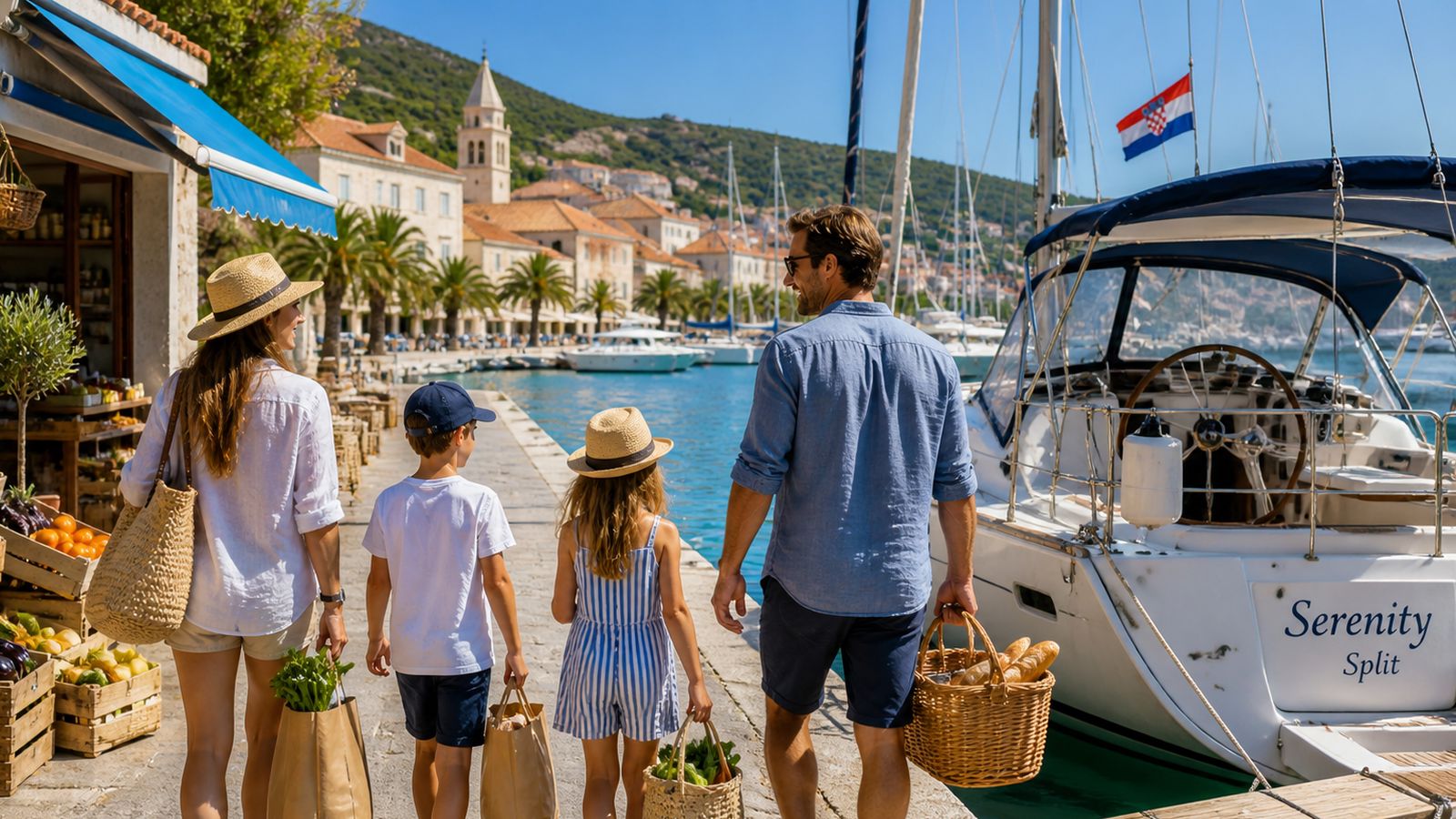
One of the genuine joys of sailing with children is that they will eat almost anything when they are hungry and salty from a morning in the sea. Provisioning for a charter is simpler than it sounds. Most Mediterranean charter bases have large supermarkets within walking distance. Stock up on staples at the beginning of the week and top up at larger island towns as you go.
A few practical notes: keep a good supply of snacks that can be eaten with one hand in a seaway (crackers, fruit, cheese portions). Make sure you have UHT milk or powdered formula if you have a baby who requires it — it is not always easy to find fresh milk on a small island. Buy more water than you think you need. Invest in a good insulated cool box in addition to the boat's built-in fridge, because charter boat fridges are often underpowered.
Skippers and Bareboat Charters
Many families charter with a professional skipper, and for first-time sailing families this is an excellent decision. A good skipper does far more than sail the boat: they choose the anchorages, handle the passages in tricky conditions, manage the dinghy, and — if you choose well — become an extra pair of hands and an enthusiastic friend for the children. Budget an additional 15–20% of the boat cost for a skipper and do not consider it an extravagance.
If you are an experienced sailor and plan a bareboat charter — taking the helm yourself — make sure your certification and logbook hours are genuinely sufficient for the area. The Mediterranean can be benign and it can be demanding, sometimes on the same day. In most charter areas, a Day Skipper certificate and 15–20 miles of offshore experience is the minimum the charter company will accept. RYA Coastal Skipper or equivalent is more appropriate for areas with significant wind exposure.
Charter Destinations at a Glance
For a broader overview of what each country offers, our destination guides cover the full picture: Boat Rental in Greece, Boat Charter in Croatia, Sailing Sardinia & Corsica (which covers the Italian side), Boat Charter in Spain, and Boat Charter in Malta. The Sporades in Greece — covered in our Sailing the Sporades guide — are another option worth considering for families who want a quieter, less-visited corner of the Greek islands.
What to Pack: The Family Charter Checklist
Boat space is finite. Pack into soft bags that can be compressed and stowed, not rigid suitcases. Beyond the usual travel items, the following are specifically useful for families with young children aboard:
Children's life jackets (bring your own, rated for your child's weight, with crotch strap)
Children's buoyancy aids for at-anchor time on deck
Reef-safe sunscreen, applied generously and often — UV reflection off the water is intense
Rash guards and UV-protective swimwear for children
Neoprene swim shoes for rocky beaches and reefs
Snorkel masks rated for children (cheap charter masks fog immediately)
Motion sickness remedy for children — patches, bands, or antihistamine syrup as your paediatrician recommends
A lightweight travel cot with a slatted base (rigid-side cots will not fit in most berths)
Non-slip bath mat for the head (bathroom) — boat heads are small and wet
Baby monitor or listening device with sufficient range for the anchor watch
Pre-made lifeline netting as a backup (available from chandleries or online)
First aid kit including children's paracetamol, antihistamine, antiseptic, and a good supply of plasters for the inevitable rope-burns and barnacle scratches
Dry bags for cameras, phones, and anything electronic
The Bigger Picture: What Children Get from Sailing
There is a practical case for family sailing — the value for money, the all-inclusive nature, the access to places you cannot reach any other way. But the more important case is harder to put in a bullet point. Children who grow up spending time on the water develop an ease with the natural world, a tolerance for uncertainty, and a capacity for the kind of focused attention that is increasingly rare. They learn to read the weather, to respect the sea, to understand that the wind can change and that you adapt. They learn patience while they wait for the wind to ease, and courage when they take the helm for the first time. These are not small things.
Start young, keep the passages short, rig the netting, and go.
Frequently asked questions
What type of boat is best for sailing with young children and toddlers?
Catamarans are generally the better choice for families with young children because they heel far less than monohulls, creating a stable platform where toddlers can move around safely. The wide beam produces a large cockpit that doubles as a play area, and seasickness is less common due to the gentler pitching motion. A minimum of 42–44 feet is recommended for a family of four adults and two small children, to allow space for a travel cot, separate sleeping areas, and storage for children's gear.
What is lifeline netting on a sailing boat and do I need it for my child?
Lifeline netting (also called safety netting or guardrail netting) is a fine-mesh net that laces between the boat's jacklines and the toe rail to create a solid barrier around the entire deck perimeter, preventing small children from slipping or rolling overboard. Standard stanchion wires are spaced wide enough for a toddler to fall through, making this netting essential for children under five. You must request it explicitly when booking — it is not standard equipment on most charter boats — and inspect it on handover day to confirm it covers all gaps including the stern.
Where is the best place in the Mediterranean to sail with a baby or young child?
The Ionian Islands in Greece are widely considered the best Mediterranean sailing destination for families with young children, thanks to gentle prevailing winds (typically 10–18 knots), short passages between islands, calm and clear water, and plentiful sheltered anchorages. The Saronic Gulf near Athens, Istria and the Kvarner Gulf in Croatia, and the La Maddalena area of Sardinia are also excellent family choices. The Cyclades and Dodecanese in Greece should be treated as options for more experienced families, as the summer meltemi wind regularly reaches 25–35 knots.
What safety equipment do I need for a sailing holiday with a baby or toddler?
Bring your own children's life jackets from home, rated for your child's exact weight and fitted with a crotch strap — charter company PFDs are often the wrong size or the wrong type for young children. Request lifeline safety netting from the charter company in writing before your trip, confirming it covers the full perimeter including the stern, and inspect it on handover day. Pack children's reef-safe sunscreen, UV-protective swimwear, neoprene swim shoes, motion sickness remedies, and a children's first aid kit. A portable backup roll of lifeline netting from a chandlery is also worth carrying as a precaution.
How do I plan a sailing itinerary that works for young children?
Keep all passages to two hours or less when sailing with toddlers and babies, and aim to leave in the morning when seas are calmest rather than waiting until afternoon when the breeze builds. Pack more activities than you think you will need for time underway — waterproof drawing books, binoculars, fishing lines, and audiobooks work well — and plan your itinerary with flexibility so you can anchor early if a child is unwell or conditions are uncomfortable. The general rule is: toddlers at anchor are almost never bored; toddlers on a long passage without stimulation are a different matter.
Do I need a skipper for a family sailing charter, or can I sail the boat myself?
Many first-time family charter groups hire a professional skipper, which is strongly recommended for families with no or limited sailing experience. A skipper costs roughly 15–20% of the boat charter cost, handles all the sailing and navigation, chooses safe anchorages, and often becomes an extra pair of hands with the children. Bareboat charters — where you sail yourself — require a recognised qualification such as an RYA Day Skipper at minimum, and RYA Coastal Skipper or equivalent for windier destinations; charter companies will ask to see your logbook and certificate before handing over the boat.


