Corinth Canal Transit Guide: Fees, Booking and What to Expect
Updated
The Corinth Canal is the spectacular shortcut between the Ionian and the Aegean, and the world's most expensive canal per mile. Here's how a transit works for a sailing yacht: current status, fees, booking, VHF procedure and what to expect between those famous limestone walls.
On this page

Every sailor who has stared at a chart of Greece has had the same thought: the Peloponnese is enormous, and there's a pencil-thin line cut straight through the top of it. That line is the Corinth Canal: 3.5 nautical miles (6.4 km) of vertical limestone connecting the Gulf of Corinth with the Saronic Gulf, and the shortcut that turns a multi-day slog around Cape Malea into a 45-minute motor between 260-foot (80 m) rock walls. It is one of the most spectacular things you can do with a boat in the Mediterranean. It is also, mile for mile, the most expensive canal transit in the world. Here's how it works.
Is the Canal Open?
Always check before you plan a passage around it: the Corinth Canal has a recent history of closures. A major landslide shut it from early 2021 until mid-2022, and since then the canal authority has been running a long-term slope-stabilisation programme, typically closing the canal outside the summer season to continue the works. Most recently it closed in November 2025 after a series of rockfalls and reopened on 17 June 2026, slightly ahead of schedule, after the main phase of stabilisation work was completed.
The modernisation programme is continuing, so assume the pattern may repeat: open through the summer sailing season, with possible closures in the off-season. The current status and announcements are on the official site, corinthcanal.com, and the operator answers around the clock on +30 27410 30886.
What Does It Cost?
The official tariff for private pleasure boats is based on length overall. Enter your boat's LOA to see the one-way fee:
Corinth Canal transit fees
- up to 6 m€70
- 6–9 m€100
- 9–15 m€100 + €29/m over 9 m
- 15–25 m€100 + €33/m over 9 m
- 25–45 m€100 + €39/m over 9 m
- over 45 m€100 + €42/m over 9 m
That puts a typical 40-foot (12 m) charter monohull at about €187 one-way, a 46-foot (14 m) boat at about €245, and a 49-foot (15 m) yacht at about €274. It's a lot of money for 3.5 nautical miles (6.4 km), famously the most expensive canal in the world per mile, but measured against 150 miles of diesel, mooring and crew time around the Peloponnese, most skippers consider it cheap. Note that towing or pilotage, where required, is charged on top, and surcharges can apply outside normal hours.
What Is the Corinth Canal?
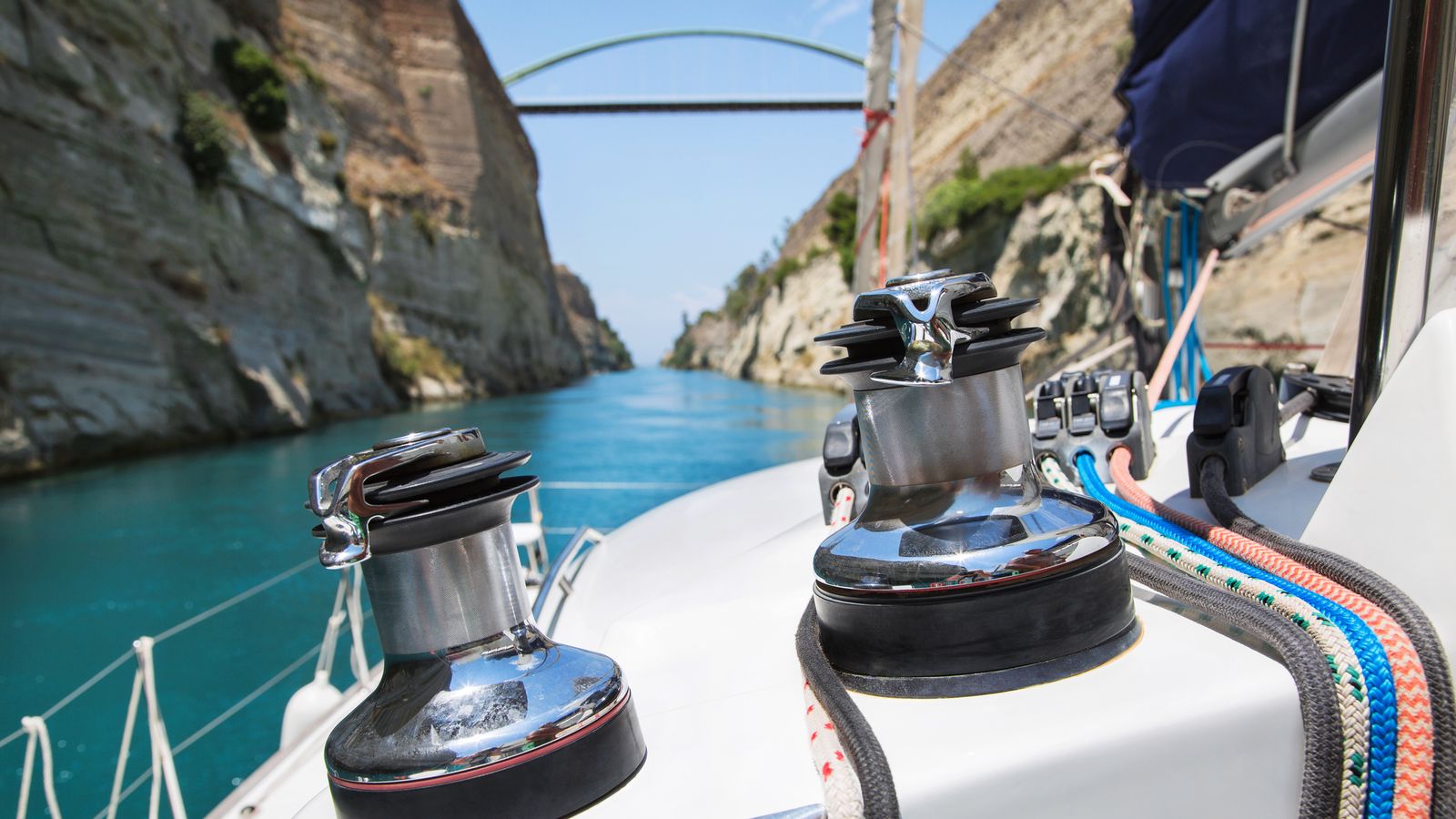
The canal cuts through the Isthmus of Corinth, the narrow neck of land that joins the Peloponnese to mainland Greece. It runs dead straight for 3.5 nautical miles (6.4 km), sea level to sea level, with no locks. What makes it unforgettable are the walls: the cut reaches about 260 feet (80 m) deep through the limestone, and from deck level it feels like sailing through a corridor with the sky reduced to a ribbon overhead.
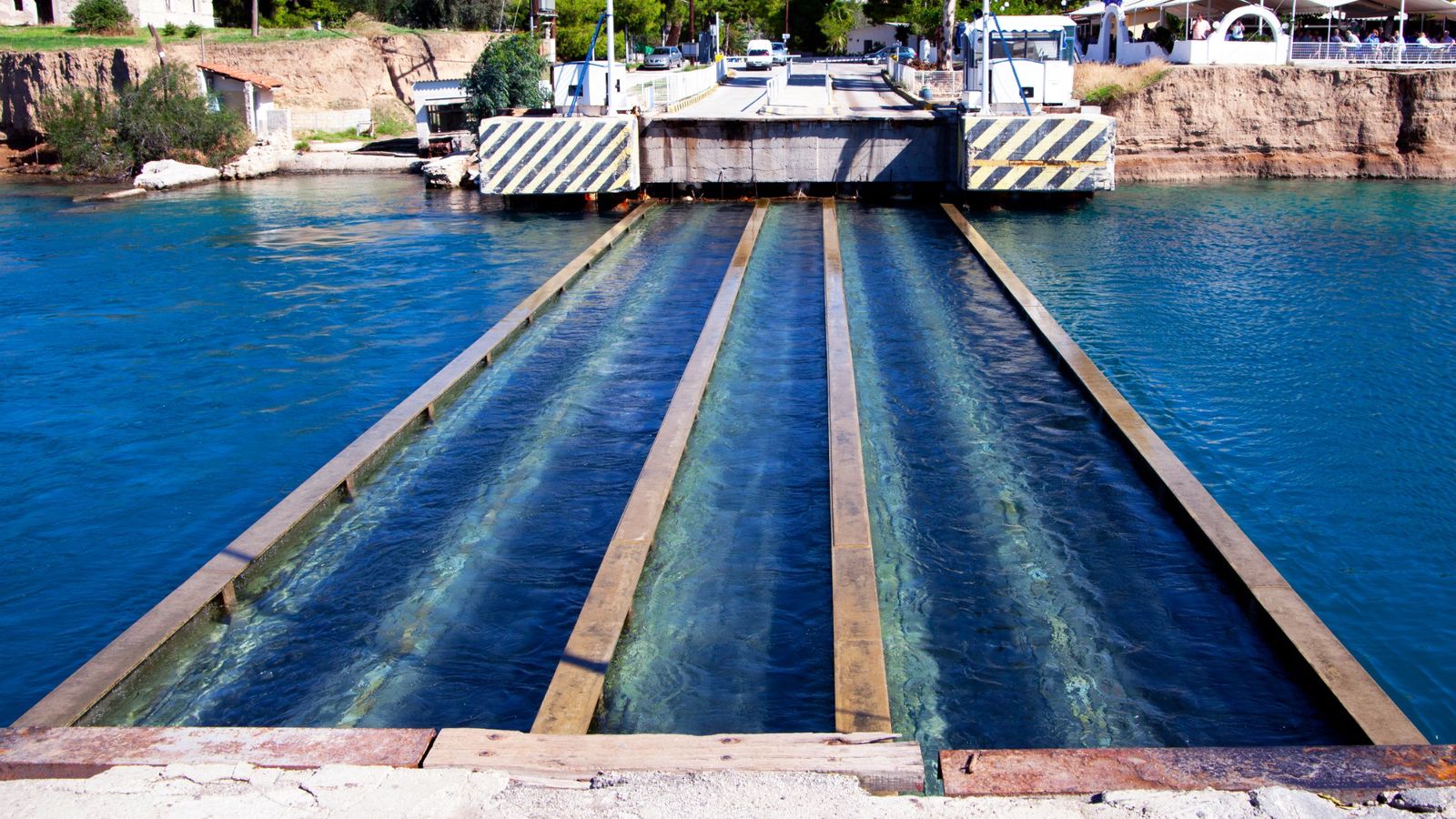
It is also genuinely narrow. The channel is about 79 feet (24 m) wide at the waterline and around 69 feet (21 m) at the bottom, with roughly 25 feet (7.5 m) of usable depth in the middle, which is why modern cargo ships gave up on it decades ago and today's traffic is almost entirely yachts, small cruise ships and tour boats. Air clearance under the road and rail bridges that cross the cut is about 170 feet (52 m), so no sailing yacht needs to worry about mast height. At each end (Isthmia on the Saronic side, Poseidonia on the Gulf of Corinth side) the canal is crossed by submersible bridges that sink below the surface to let vessels pass, a rarity you won't see anywhere else in the Mediterranean.
Why It Matters for Sailors
The canal is the only shortcut between Greece's two great cruising grounds. Without it, getting a boat between the Ionian and the Saronic Gulf or Cyclades means rounding the southern capes of the Peloponnese (including Cape Malea, one of the most notorious stretches of water in Greece), adding roughly 150 nautical miles and, in bad weather, several days of waiting. Through the canal, Athens to the Ionian becomes a comfortable one-week delivery. We've written up that passage in detail in our Ionian-to-Aegean delivery route guide.
For charterers the canal is mostly relevant on one-way charters, deliveries and longer two-week itineraries, and as a bucket-list experience in its own right. Some charter companies restrict canal transits or charge for them, so check your contract before you plan one into a route.
How a Transit Works
The canal is one-way traffic only: convoys alternate direction, so on arrival you wait your turn, then follow the vessels ahead of you through. In practice a transit looks like this:
1. Give notice or book ahead. Commercial traffic files ETAs well in advance; for a yacht it's enough to announce yourself a few hours out, but in high season it's worth booking your slot via the official site or by email so you're in the schedule. The canal operates day and night through the season, though it has traditionally closed one weekday (usually Tuesday daytime) for maintenance, so confirm the day's schedule when you book.
2. Call "Isthmia Pilot" on VHF channel 11 as you approach either entrance. The controllers speak English, will tell you where to wait and when your convoy leaves. At Isthmia (the Saronic end) yachts wait alongside the quay by the control tower; at Poseidonia (the western end) you hold off the entrance until called in.
3. Pay at Isthmia. Tolls are settled at the control station on the Saronic side: westbound boats pay before entering, eastbound boats after exiting. Cash and cards (Visa/Mastercard) are accepted, and fees can also be arranged in advance online.
4. Motor through. Transit is under engine only (no sailing in the canal), at around 6 knots with no overtaking. The passage takes 30 to 45 minutes. Keep to the middle, watch the wash bouncing off the walls, and have your camera ready: the rail bridge crossing 165 feet (50 m) above you is the classic shot.
Practical Tips
Currents in the canal run up to 2 to 3 knots depending on the wind and the water-level difference between the two gulfs, so expect your speed over ground to differ noticeably from the log. Wind funnels along the cut and can gust unpredictably off the walls. Fender up before you enter: you'll likely lie alongside the rough concrete quay at Isthmia to pay, and wash from vessels ahead reflects off the canal walls in a confused chop. If you're on a flybridge or foredeck, keep an eye out for the bungee jumpers who leap from the pedestrian bridge at the midpoint in summer.
Time your arrival with some slack: if a convoy has just left in the opposite direction, you may wait an hour or more for your turn. It's a fine excuse for a swim off Isthmia beach or a coffee at the canal-side cafés watching the submersible bridge do its trick.
A Canal 2,500 Years in the Making
Few pieces of infrastructure anywhere have a backstory like this one. The tyrant Periander of Corinth first planned a canal here in the 7th century BC; when the digging proved impossible, his engineers built the Diolkos instead, a paved trackway over which ships were dragged across the isthmus on wheeled cradles, traces of which are still visible beside the western entrance. The Roman emperor Nero broke ground on an actual canal in 67 AD, reportedly turning the first sod himself with a golden shovel before putting six thousand labourers to work; the project died with him a year later.
The canal was finally completed in 1893, after eleven years of digging by French and then Greek companies, arriving just in time to be too narrow for the steadily growing steamships it was meant to serve. It has led a dramatic life since: retreating German forces blew the sides in and dumped rolling stock into the cut in 1944, and the unstable sedimentary rock that defeated Periander still sheds onto the channel today, which is exactly what the current stabilisation programme is working to fix.
Planning a Greek Charter?
If the canal has you dreaming about Greek waters, start with our complete guide to boat rental in Greece, then pick your side of the isthmus: the gentle, green Ionian to the west or the Saronic and Cyclades to the east.
Frequently asked questions
How much does it cost to transit the Corinth Canal on a yacht?
The official fee for private pleasure boats is based on length overall (LOA). A typical 40-foot (12 m) charter monohull pays about €187 one-way, a 46-foot (14 m) yacht pays about €245, and a 49-foot (15 m) yacht pays about €274. Towing or pilotage fees, where required, are charged on top, and surcharges can apply outside normal operating hours.
Is the Corinth Canal open for sailing?
The canal has been operating on a seasonal pattern: open through the summer sailing season and closed during the off-season for slope-stabilisation work. Most recently it closed in November 2025 after rockfalls and reopened on 17 June 2026. Always check the current status at corinthcanal.com or call the operator at +30 27410 30886 before planning a passage around it.
How do you book a Corinth Canal transit and where do you pay?
Call 'Isthmia Pilot' on VHF channel 11 as you approach either entrance, and the English-speaking controllers will tell you where to wait and when your convoy departs. Tolls are paid at the Isthmia control station on the Saronic side: westbound boats pay before entering and eastbound boats after exiting. Cash and cards (Visa/Mastercard) are accepted, and fees can also be arranged in advance online.
What is it like to sail through the Corinth Canal and how long does it take?
The canal is 3.5 nautical miles (6.4 km) long with walls rising about 260 feet (80 m) above the channel, which narrows to around 79 feet (24 m) at the waterline. Transiting under engine only at roughly 6 knots, the passage takes 30 to 45 minutes. Currents can run 2 to 3 knots depending on conditions, and wind funnels unpredictably through the cut, so expect some chop especially while waiting at the Isthmia quay.
Why would a charter sailor use the Corinth Canal instead of sailing around the Peloponnese?
Without the canal, moving a boat between the Ionian and the Saronic Gulf or Cyclades requires rounding the southern capes of the Peloponnese, including the notorious Cape Malea, which adds roughly 150 nautical miles and potentially several days in bad weather. The canal turns that journey into a 45-minute motor, making it particularly valuable on one-way charters, deliveries, and two-week itineraries. Some charter companies restrict or charge extra for canal transits, so check your contract before building one into a route.
What are the dimensions of the Corinth Canal and can a sailing yacht fit through it?
The canal runs at sea level with no locks and offers about 170 feet (52 m) of air clearance under the road and rail bridges, so mast height is not a concern for sailing yachts. The channel is about 79 feet (24 m) wide at the waterline, which is why modern cargo ships no longer use it but yachts, small cruise ships, and tour boats transit routinely. Each end of the canal also features rare submersible bridges that sink below the surface to let vessels pass.


