Sailing Mallorca & Menorca: Routes, Tips & What to Expect
Updated
Two islands, one week, and more turquoise calas than you could ever visit — Mallorca and Menorca make up one of the Mediterranean's most satisfying sailing circuits, whether you want buzzing marinas or genuine solitude.
On this page

Few sailing grounds in the Mediterranean rival the clarity, drama, and sheer variety of the Balearic Islands. Mallorca and Menorca sit at the heart of this archipelago, separated by just 35 nautical miles of open water yet remarkably different in character. Mallorca dazzles with a lively sailing infrastructure, dramatic limestone cliffs, and buzzing marinas. Menorca counters with a quieter, more untouched coastline, UNESCO Biosphere Reserve status, and anchorages so remote you'll wonder if anyone else has found them. Together, they make for one of the most rewarding week-long sailing circuits in the western Mediterranean.
What Makes This Area Unique
The Balearics have been a sailor's playground for centuries, and it's easy to see why. The water is genuinely extraordinary — visibility of 20 to 30 meters is routine, and the gradient of blues as you approach a cala (cove) rivals anything the Greek islands can offer. The combination of Mallorca's busy, well-equipped ports and Menorca's near-pristine natural anchorages on a single itinerary gives you the best of both worlds: reliable provisioning and infrastructure on one end, and real solitude on the other.
Mallorca alone has over 200 calas, ranging from village harbors with excellent restaurants to secret pebble beaches accessible only by sea. The Serra de Tramuntana mountain range, which runs along the northwestern coast and is listed as a UNESCO World Heritage Site, drops almost sheer into the sea, creating a series of dramatic anchorages with dark water and pine-scented air. In contrast, Menorca's southern coast opens into a string of wide, shallow inlets with bone-white sand and calm, family-friendly water, while the wilder north coast faces the Tramuntana winds with a raw, Atlantic-like energy.
The cultural dimension is equally compelling. Menorca's harbor towns of Ciutadella and Maó carry centuries of Moorish, Spanish, and British colonial history in their architecture. Mallorca's Palma de Mallorca is a genuinely great city — one of the best in the Mediterranean — with a Gothic cathedral, tapas bars, and a yacht harbor that somehow manages to be both glamorous and accessible.
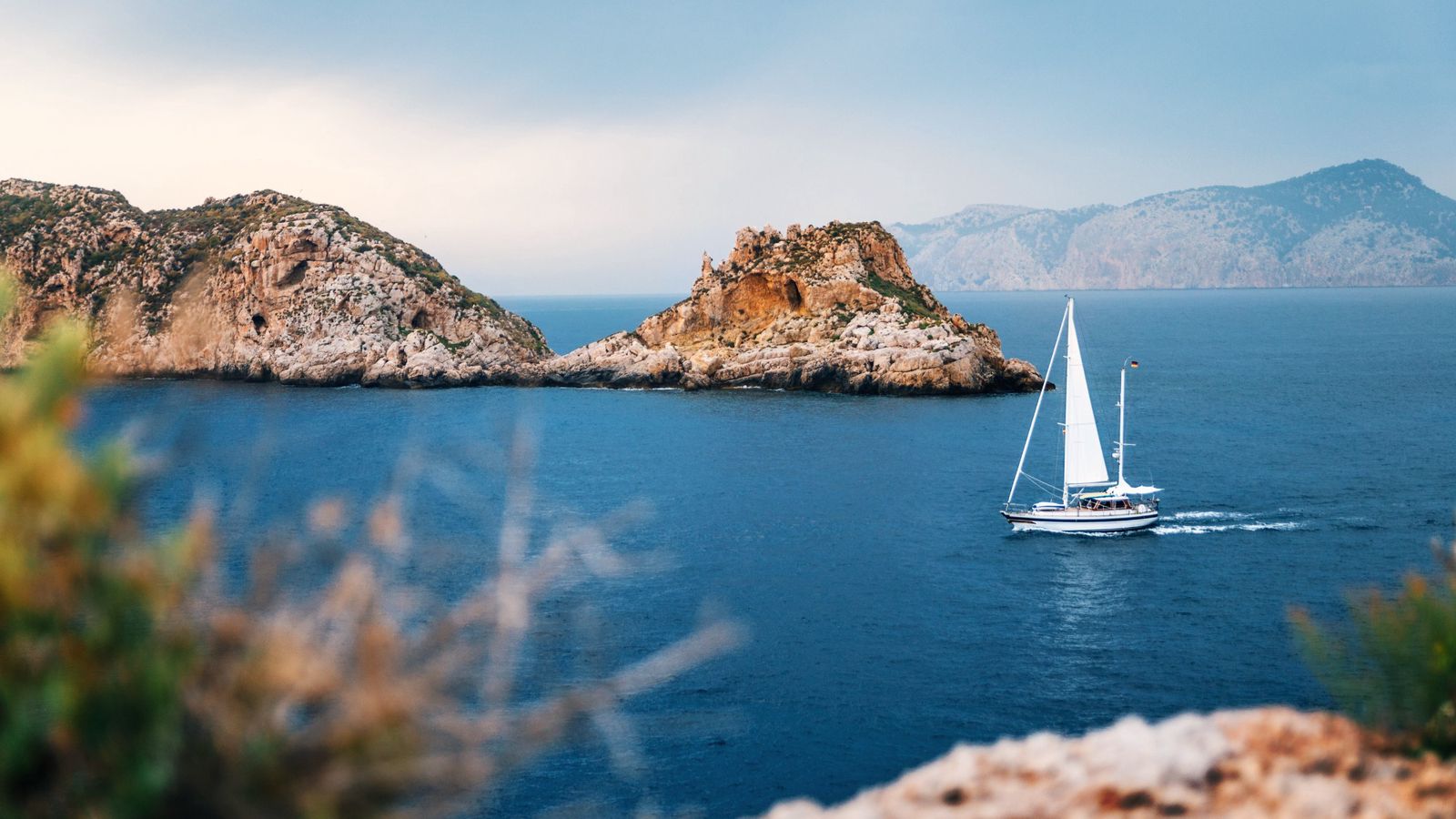
Sailing Conditions
The Balearic season runs from April through October, with July and August being the most crowded and often the hottest. For sailing conditions, June and September are the sweet spot: reliable wind, warm but not punishing temperatures, and anchorages that aren't packed to capacity.
The dominant summer wind is the Embat, a sea breeze that builds from the south or southwest during the afternoon, typically reaching 10 to 18 knots. It's predictable enough that you can plan passages around it, though it can occasionally clock to the north and strengthen. The infamous Tramuntana is a northerly wind that can arrive with little warning, particularly on Menorca's exposed northern coast, and can gust significantly. The Llevant (easterly) and Llebeig (southwest) are less frequent but worth monitoring.
Between Mallorca and Menorca, the Es Freu channel and the broader open-water crossing can kick up a short, steep swell when the wind is up, especially with a Tramuntana blowing. Passage from Palma to Menorca is roughly 100 nautical miles — doable as a day sail in good conditions, but many sailors split it with a stop at the north or east coast of Mallorca. Within Mallorca's coasts, most passages are under 20 miles and conditions are manageable for competent beginners.
Who This Sailing Area Is Best For
Mallorca and Menorca together suit a wide range of sailors, but the experience does vary significantly depending on your level.
Beginners and families will feel most at home in Mallorca's sheltered eastern bays — the Badia de Pollenca and the Badia d'Alcudia in the north, and the calm inlets around Portocolom and Cala d'Or in the southeast. Distances between stops are short, marinas are excellent, and you're never far from help. First-time charterers frequently choose this circuit for exactly that reason. The summer Embat gives reliable afternoon sailing without being overwhelming.
Intermediate and experienced sailors will relish the open-water crossing to Menorca and the challenge of the island's northern anchorages, particularly in the Tramuntana season. The more remote calas require anchoring or picking up a buoy rather than berthing in a marina, so a basic comfort with anchoring is important. Passage planning between Mallorca and Menorca also rewards sailors who are comfortable with a 6-to-8-hour open-water passage.
Liveaboard adventurers who want genuine solitude will find it on Menorca's south coast in June or September — places like Cala Macarella or Cala Turqueta where you can anchor, swim, and watch the sunset with only a handful of other boats for company.
Suggested 7-Day Itinerary: Palma to Menorca and Back
This itinerary starts and finishes in Palma de Mallorca, which has the best flight connections and charter infrastructure in the islands. Check-in on Day 1 starts at 1pm, with access to the boat from 3pm onward — use the morning to provision and explore Palma's old town before you get aboard.
Day 1: Palma de Mallorca — Settling In
Fly in, check in from 1pm, and board from 3pm. Use the afternoon to get familiar with the boat, top up provisions at the marina's nearby supermarkets, and have your skipper briefing. In the evening, walk into Palma's old quarter for a proper introduction to the city. The Born and La Llotja neighborhoods are packed with excellent tapas bars and restaurants at every budget level. Sleep aboard in the marina.
Marina: Real Club Náutico de Palma or Club de Mar Mallorca are the most central, well-equipped options. Both have excellent facilities and easy access to the city center.
Day 2: Palma to Port de Sóller — Tramuntana Coast (approx. 25nm)
Head northwest along the spectacular Tramuntana coast. The cliffs here are among the most dramatic in the Mediterranean, rising straight from the sea in dark limestone walls. Dolphins frequently accompany boats along this stretch. Port de Sóller is a beautifully sheltered circular bay — one of the few natural harbors on this exposed coast — with a pretty village, a vintage electric tram that runs up to Sóller town, and good restaurants along the waterfront.
Aim to arrive by mid-afternoon; the harbor fills up quickly in peak season. The Port de Sóller marina assigns berths on arrival. Anchor in the outer bay if the marina is full — holding is good on sand.
Don't miss: The tram to Sóller and the fresh orange juice market in the town square. Sóller is surrounded by orange and lemon groves and the juice is extraordinary.
Day 3: Port de Sóller to Formentor — Peninsula Anchorage (approx. 30nm)
Round the dramatic headlands of Cap de Formentor, arguably the most spectacular piece of sailing scenery in the western Mediterranean. The lighthouse perched at the very tip of the peninsula is one of those sights that stays with you. On the eastern side of the cape, Cala Pi de la Posada and the waters around Formentor beach offer good anchorage in settled conditions, and the famous Formentor Hotel sits above the tree line in the pines.
Alternatively, duck into the large, well-protected Badia de Pollenca and take a berth at the Puerto Pollensa marina — an excellent base with good restaurants, a gentle beach town atmosphere, and easy provisioning. This is a popular stop for families. Distance from Sóller: approximately 30 nautical miles.
Day 4: Pollensa to Maó (Menorca) — The Crossing (approx. 55–60nm)
This is the big day — the open-water crossing to Menorca. Depart early, ideally before 8am, to make Maó by mid-afternoon. The crossing is straightforward in calm conditions but can be lumpy with any northerly component in the wind. Maó (Mahon) has one of the finest natural harbors in the world — a long, narrow inlet stretching 5km inland, lined with Georgian townhouses built during British occupation in the 18th century.
The entrance to Maó harbor is spectacular: you pass between high cliffs, then the harbor opens up into a wide, calm anchorage. Pick up a mooring in the inner harbor or take a berth at one of the Club Náutico de Mahón pontoons. The city is compact and walkable, with excellent seafood restaurants on the harbor waterfront.
Insider Tip: If the wind forecast shows a Tramuntana building, consider doing the crossing a day early or delaying — the channel between the islands can be uncomfortable with a north wind. Always check the AEMET marine forecast the night before.
Day 5: Maó to Cala Macarella — Menorca's South Coast (approx. 30nm)
This is the day many sailors cite as the highlight of the whole trip. Work your way westward along Menorca's beautiful south coast, stopping at calas as conditions allow. Cala Galdana is a good intermediate stop — a sheltered horseshoe bay with a beach, a restaurant on the cliff, and mooring buoys maintained by the Govern Balear (a fee applies, but they are good value).
Continue to Cala Macarella, arguably the most beautiful anchorage in the Balearics. The water is a shade of aquamarine that seems impossible. There's a small beach bar, a hiking trail over the headland to the even quieter Cala Macarelleta, and on a September evening, very few other boats. Pick up one of the yellow mooring buoys — anchoring is restricted in many Menorcan calas to protect the posidonia seagrass.
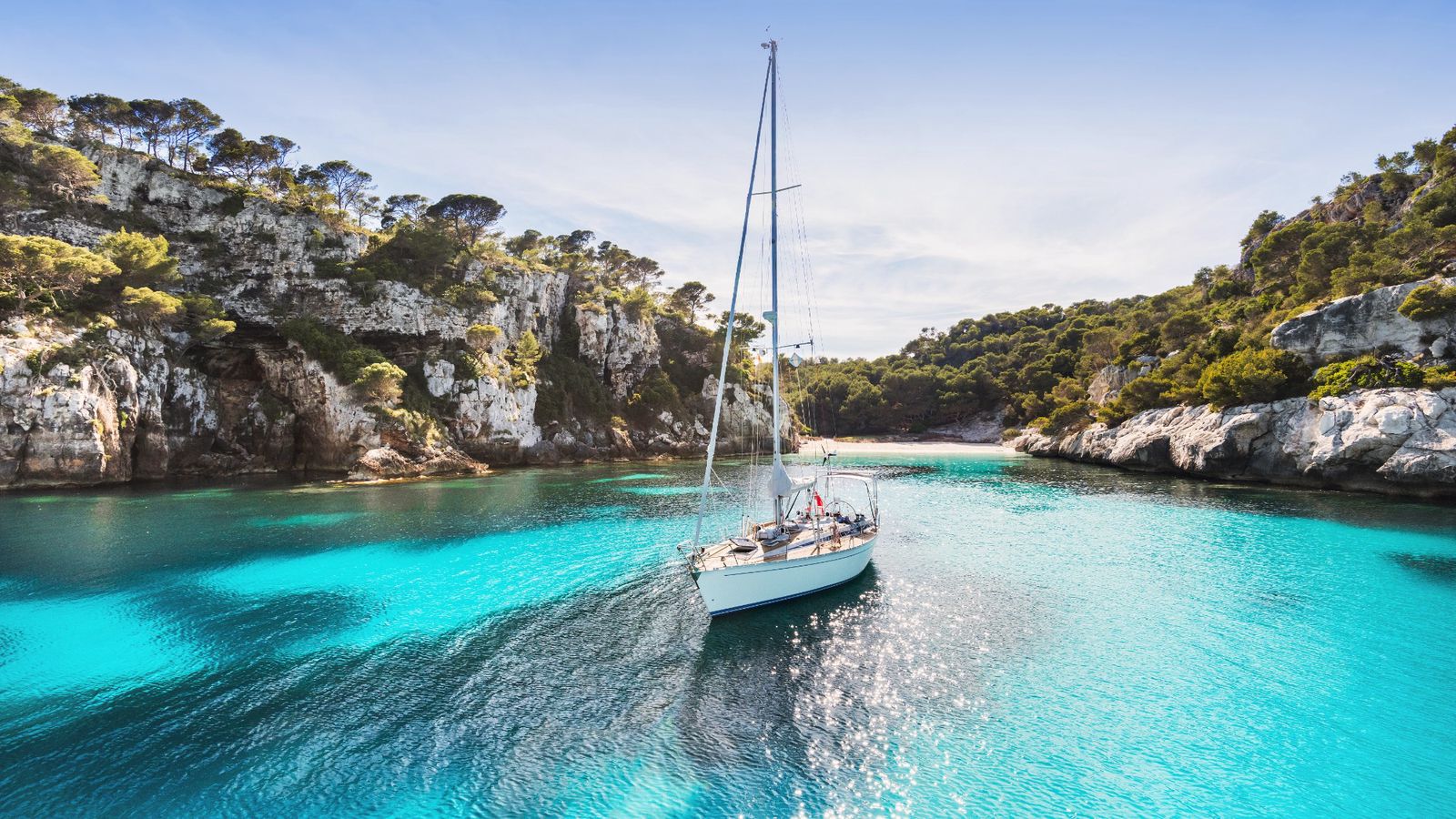
Day 6: Cala Macarella to Ciutadella and back toward Mallorca (approx. 15nm to Ciutadella)
Spend the morning at anchor in Macarella — swim, kayak, and have a slow breakfast. Then sail the short distance to Ciutadella, Menorca's old capital, which sits at the end of a long, narrow harbor inlet on the island's western tip. The old city is extraordinary: a warren of limestone palaces, Baroque churches, and tapas bars that feel genuinely local rather than tourist-oriented.
Berthing in Ciutadella is tight — the harbor is narrow and the quays fill quickly in summer. The inner harbor quay is the most atmospheric spot. Alternatively, anchor just outside the harbor entrance and take the dinghy in. Sunset over Ciutadella harbor is one of the great Mediterranean evenings.
If you want to begin the return to Mallorca, you can depart Ciutadella in the late afternoon with a favorable Embat and sail overnight or into the evening to reach the east coast of Mallorca by morning — roughly 35nm. More conservative is to stay overnight in Ciutadella and cross early the next morning.
Day 7: Return to Palma — East Coast of Mallorca and Final Night
Cross back from Ciutadella to Mallorca's eastern coast, arriving at Portocolom or Cala d'Or. Portocolom is a gorgeous natural harbor with a small village, colored fishermen's houses reflected in the water, and an easy, relaxed atmosphere — a perfect final-night stop before returning to Palma. The marina is well-equipped and the village has excellent restaurants.
If time allows, have a final swim in one of the nearby calas before the 2-to-3-hour motor-sail back to Palma for your handover the following morning. Boats are typically returned by 9am on the final day, so an early Portocolom departure works well.
Key Stops at a Glance
Palma de Mallorca
The capital and sailing hub. Excellent provisioning, world-class marinas, a magnificent Gothic cathedral, and a genuinely great restaurant scene. The best city base in the Balearics.
Port de Sóller
The only significant harbor on the wild Tramuntana coast. Sheltered, beautiful, and with easy access to the charming inland town of Sóller via vintage tram. A highlight of the northwest coast.
Puerto Pollensa
A large, well-protected bay in northern Mallorca with a relaxed, slightly upscale resort town. Good infrastructure, reliable provisioning, and excellent beaches. Great for families.
Maó (Mahon), Menorca
One of the finest natural harbors in the world. The city's British colonial architecture is unique in the Mediterranean, and the harbor entrance — flanked by high cliffs — is genuinely dramatic. Excellent seafood restaurants on the waterfront.
Cala Macarella, Menorca
The jewel of Menorca's south coast. Vivid turquoise water, a white-sand beach, and a small bar accessible by hiking path. Mooring buoys are available; anchoring is restricted to protect the seagrass. One of the most beautiful anchorages in the western Mediterranean.
Ciutadella, Menorca
Menorca's old capital on the western tip of the island. A stunning limestone old town with a characterful narrow harbor, excellent local tapas bars, and some of the best sunsets in the Balearics. Worth the effort of navigating the tight harbor entrance.
Portocolom, Mallorca
A hidden gem on Mallorca's eastern coast. The natural harbor is ringed with brightly painted fishermen's houses, and the village has an authenticity that many more touristy spots lack. A perfect, peaceful final stop before the return to Palma.
Mooring and Marina Tips
The Balearics are well-served by marinas but can be extremely busy in July and August, when advance booking is essential. In June and September, it's usually possible to call ahead or arrive and find a berth without pre-booking, but it's always worth calling on VHF Channel 9 or the marina's direct number as you approach.
Many of the best stops — particularly on Menorca's south coast — are anchorages rather than marinas. Menorca's protected calas use a mooring buoy system managed by the Balearic Government, with wardens collecting fees by dinghy in peak season. Buoy fees range from approximately €15 to €30 per night depending on size and location. Anchoring outside designated zones is increasingly restricted to protect seagrass, so always check the latest charts and local rules.
Anchoring in Mallorca's calas is generally more permissive, though some bays have restrictions. A good-quality anchor and at least 40 meters of chain are standard on Balearic charter boats — make sure your charter company confirms this before you take the boat.
Insider Tip: The PORT app (available on iOS and Android) is used by most marina booking systems in Spain. Many Balearic marinas now require booking through this platform, and it shows real-time availability. Download it before you leave home.
Cost Expectations
The Balearics sit at the mid-to-upper end of Mediterranean charter costs, reflecting the quality of the infrastructure and the popularity of the destination. Here is a realistic breakdown for a 7-day trip:
Charter cost: A 40-to-45-foot sailing yacht for 7 days in June costs approximately €2,500 to €4,500, depending on the boat's age and specification. July and August prices jump significantly — the same boat may cost €4,000 to €7,000. September offers good value again. These prices are for bareboat charter; add 20 to 30 percent for a skippered option.
Fuel: Budget approximately €80 to €150 for the week, depending on how much motoring you do. The crossing to Menorca in calm conditions may require significant motoring.
Marina fees: Expect €30 to €90 per night in a marina for a 40-foot boat, depending on the port. Palma marinas are at the higher end. Mooring buoys in Menorca's calas cost €15 to €30. Anchoring is free where permitted.
Food and drink: Mallorca and Menorca offer excellent value compared to French or Italian marinas. Budget €30 to €50 per person per day for a mix of eating aboard and dining out. A proper sit-down dinner with wine in a harbor restaurant typically costs €25 to €45 per person.
Provisioning: Stock the boat in Palma before departure — the supermarkets near the major marinas (Mercadona is the local favorite) offer very good prices. Re-provisioning in smaller ports is possible but more expensive.
Overall budget for a group of 6: A realistic all-in estimate, excluding flights, is approximately €700 to €1,200 per person for the week in shoulder season. Peak season pushes this higher.
Insider Tips
Tip 1 — Time your Menorca crossing for the Embat: The afternoon sea breeze reliably fills in from the southwest during summer. If you depart for the Menorca crossing around 7am and conditions are good, you'll often pick up the Embat by late morning and have a fast, enjoyable reach across rather than a motoring slog. A good weather window is everything on this passage.
Tip 2 — Visit Menorca's north coast calas if conditions allow: Most sailors stick to Menorca's sheltered south coast, but if you get a settled weather window, Cala Pregonda and Cala Binimel·là on the north coast are dramatically beautiful and almost always empty. They require exposure to the north, so check the forecast carefully and have an exit plan if the Tramuntana builds. The effort is worth it.
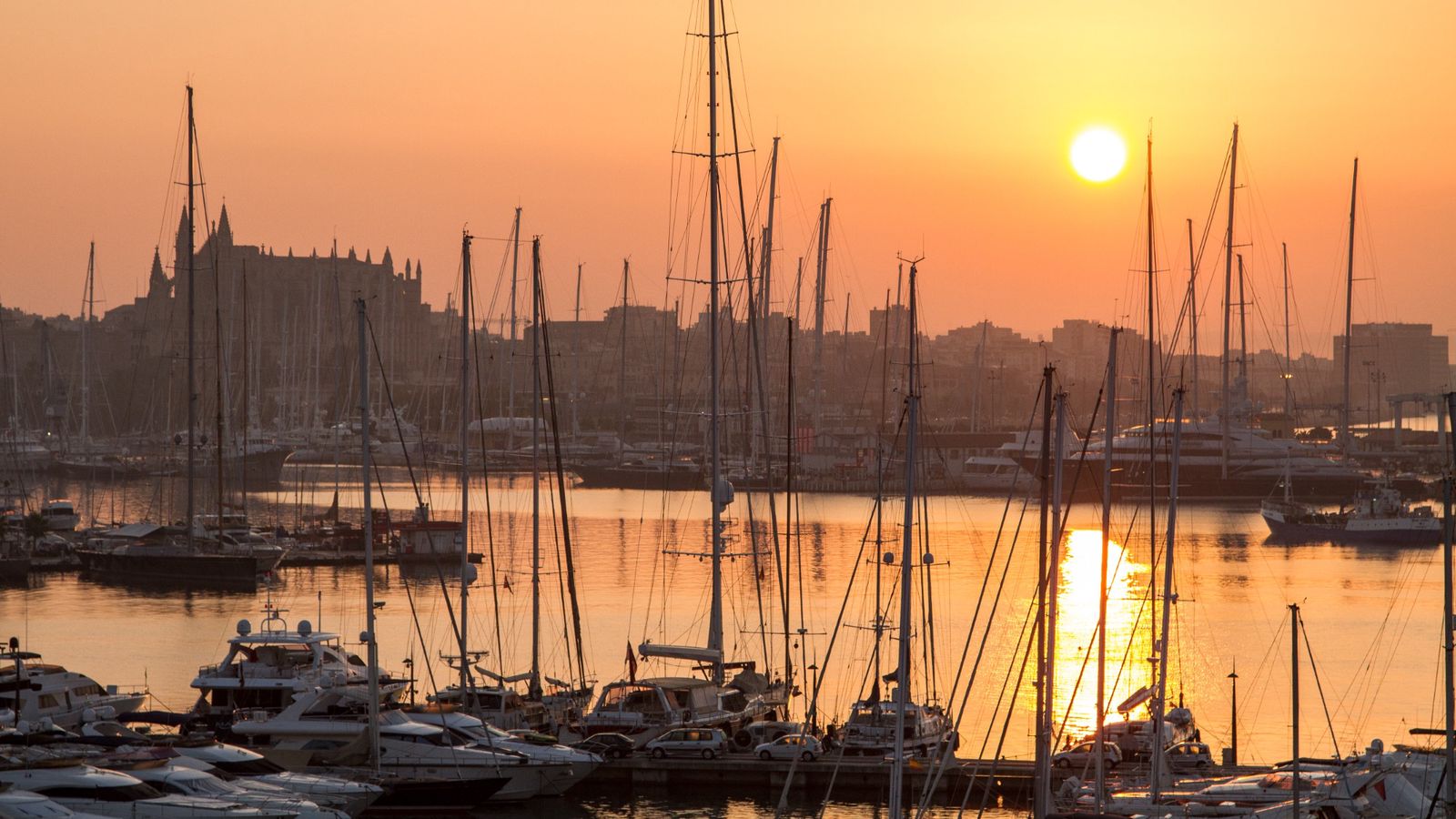
Tip 3 — Palma is a city worth exploring properly: Many sailors treat Palma as just a logistics stop. That's a mistake. The old town is genuinely one of the great Mediterranean cities — the Cathedral de Mallorca seen from the sea as you approach is one of those images that defines a trip. Arrive early on Day 1, walk the Born, visit the cathedral, and have dinner at one of the tapas bars near the Mercat de l'Olivar. You'll start the sailing week in exactly the right mood.
Frequently asked questions
What is the best time of year to sail Mallorca and Menorca?
The best time to sail Mallorca and Menorca is June or September. Wind is reliable, temperatures are warm but manageable, marinas are less crowded than in peak summer, and anchorages in places like Cala Macarella are far more accessible. July and August offer the most stable weather but bring the highest prices and the most crowded anchorages — advance marina booking is essential during those months.
How difficult is the sailing crossing between Mallorca and Menorca?
The crossing from Mallorca to Menorca is roughly 55 to 60 nautical miles from Palma, or about 35 nautical miles from Mallorca's northeast tip near Pollensa. In settled summer conditions with the afternoon sea breeze, it is an enjoyable passage, but the channel can become choppy when a Tramuntana (northerly wind) is blowing. It is suitable for competent sailors comfortable with a day-long offshore passage; beginners should check the forecast carefully and consider waiting for a good weather window.
Can you anchor freely in Menorca's calas, or do you need to use mooring buoys?
Many of Menorca's most beautiful anchorages — particularly on the south coast, including Cala Macarella, Cala Turqueta, and Cala Galdana — use a mooring buoy system managed by the Balearic Government. You pick up a yellow buoy and pay a warden who collects fees by dinghy, typically €15 to €30 per night depending on boat size. Anchoring is increasingly restricted in these calas to protect the protected posidonia seagrass meadows below.
How much does it cost to charter a sailboat in Mallorca and Menorca for a week?
A bareboat charter of a 40-to-45-foot sailing yacht in the Balearics costs approximately €2,500 to €4,500 per week in June or September, rising to €4,000 to €7,000 in July and August. Add marina fees of €30 to €90 per night, fuel of approximately €80 to €150 for the week, and food and drink at roughly €30 to €50 per person per day. For a group of six in shoulder season, an all-in budget of €700 to €1,200 per person for the week is realistic, excluding flights.
What winds should I expect when sailing the Balearic Islands?
The predominant summer wind in the Balearics is the Embat, a sea breeze that builds from the south or southwest each afternoon, typically reaching 10 to 18 knots. The Tramuntana is a northerly wind that can arrive with little warning and is particularly powerful on Menorca's north coast. The Llevant (east wind) and Llebeig (southwest) also occur. Summer sailing is generally manageable for all experience levels, but the Tramuntana can make the open channel between the islands and Menorca's northern anchorages challenging.
Is Mallorca suitable for beginner sailors, or do you need experience?
Mallorca's eastern and northern coasts — particularly the Badia de Pollenca and the sheltered bays around Portocolom and Cala d'Or — are ideal for beginner sailors or first-time charterers. Passages are short, marinas are excellent, the afternoon sea breeze is gentle and predictable, and you're never far from support. The open-water crossing to Menorca and the island's more exposed northern anchorages are better suited to sailors with more offshore experience.


