Sailing the Aeolian Islands: Volcanoes, Anchorages & Sicilian Waters
Published
Seven volcanic islands, one active volcano that erupts every twenty minutes, and sailing passages short enough to leave you plenty of time ashore — the Aeolian Islands off Sicily are one of the Mediterranean's most dramatic and underrated charter destinations. Here's everything you need to know before you go.
On this page

Seven volcanic islands rising from the cobalt waters north of Sicily — the Aeolian Islands are one of those sailing destinations that feels genuinely mythological the moment you drop anchor. The ancient Greeks believed this was where Aeolus, god of the winds, kept his legendary bag of gales. Stand on the deck at dusk watching Stromboli belch fire into the night sky, and you'll understand exactly why.
For sailors, the Aeolians offer something increasingly rare in the Mediterranean: concentrated drama within a compact, manageable sailing area. The entire archipelago spans roughly 50 nautical miles from tip to tip, meaning you can visit all seven islands on a single charter without clocking hundreds of offshore miles. Yet the variety packed into that small footprint — active volcanoes, thermal mud pools, pristine anchorages, obsidian cliffs, and some of Sicily's best seafood — is staggering.
[Image: Aerial view of the Aeolian Islands from above, showing volcanic peaks rising from vivid blue Mediterranean water, with a sailing yacht anchored in a clear bay below]
What Makes the Aeolians Unique
The Aeolian Islands — Lipari, Vulcano, Salina, Panarea, Stromboli, Filicudi, and Alicudi — form a UNESCO World Heritage Site, recognized for their outstanding volcanic geology. These aren't just scenic hills with a bit of geothermal steam. Stromboli has been in nearly continuous eruption for 2,000 years, earning it the nickname "Lighthouse of the Mediterranean." Vulcano still bubbles with fumaroles and sulfurous mud baths at the crater's edge. This is an active volcanic landscape, and sailing through it carries an energy that no other Mediterranean destination can match.
Beyond the geology, the culture is fiercely local. The Aeolians were historically so isolated that each island developed its own character. Lipari is the busy commercial hub with the best provisioning. Panarea is the stylish playground for Italian summering elites. Alicudi has no cars, no roads, no scheduled electricity — residents use donkeys and a generator. Filicudi feels like stepping back 40 years. These contrasts make island-hopping feel like genuine exploration rather than a tick-the-box cruise.
The waters are extraordinarily clear throughout the archipelago. In the right anchorages, visibility can exceed 30 meters, making this a paradise for snorkelers and divers aboard. The seabed is volcanic rock and posidonia grass, colors shifting from near-black in the depths to impossible turquoise in the shallows.
Sailing Conditions: Wind, Swell, and Difficulty
The Aeolians sit in a zone where Mediterranean wind patterns converge with the geography of southern Italy and Sicily, creating conditions that can be wonderfully settled or genuinely challenging — sometimes within the same afternoon.
The dominant summer wind is the Maestrale (northwest), which typically blows Force 3–4 with pleasant sailing conditions for most of June through August. However, the Tramontane (north) and Scirocco (south) can both push through with little warning, particularly in June and September. The passages between the islands, especially the channel between Lipari and Vulcano and the open waters east of Stromboli, can produce short, steep chop when the wind pipes up against an adverse current. The Aeolians are not a place for sailors who are anxious about a bit of motion.
Inter-island passages are short — typically 10 to 20 nautical miles — so most legs can be completed in two to four hours. This is a major advantage for managing weather windows. If conditions look unsettled, you can sit in a comfortable anchorage and monitor the forecast without losing significant time.
The volcanic topography creates its own microweather. High peaks like Stromboli (924 meters) and Salina's twin craters can channel and accelerate wind significantly on their lee shores. Always check the local VHF forecasts in Italian (or use a reliable app) and be ready for the wind to behave differently than the synoptic chart suggests once you're in the island shadows.
Who Should Sail Here
The Aeolians are best suited to sailors with some offshore experience — at minimum a competent RYA Day Skipper or equivalent who has handled 20–25 knot conditions in open water. The passages are short, but the anchorages can be rolly in a northerly swell, and the lack of fully protected marinas on several islands means you'll occasionally need to depart at anchor or on a mooring buoy in conditions that are less than flat calm.
That said, experienced beginners sailing with a professional skipper or joining a skippered charter will find the Aeolians enormously rewarding. The proximity of the islands means no single passage is especially long or demanding, and the sailing rewards — visual drama, warm water, easy provisioning at Lipari — are immediate and obvious.
Advanced sailors will find more challenge in the passages to the outer islands (Filicudi and Alicudi lie further west and can produce longer open-water legs in a stiff Maestrale) and in navigating the anchorage at Strombolicchio in any kind of swell.
Best Time to Sail the Aeolians
The sailing season runs from late April through October, with the sweet spot sitting in late May to mid-June and the first three weeks of September. These shoulder periods offer warm water (20–24°C sea temperature), settled Maestrale conditions, uncrowded anchorages, and lower charter prices than the peak July and August period.
July and August are high season. The islands are popular with Italian, French, and German charter fleets simultaneously, and mooring buoys at Panarea and Stromboli can be claimed by midday. Panarea's famous evening anchorage near the port is essentially a floating social event by August, complete with superyachts and party boats. If you value solitude, come in June or September.
Avoid May for Stromboli anchorages — the volcanic activity can make the approach rolly and the mooring field uncomfortable in the residual winter swell. October can offer exceptional sailing but requires flexibility around autumn depressions that occasionally push through from the northwest.
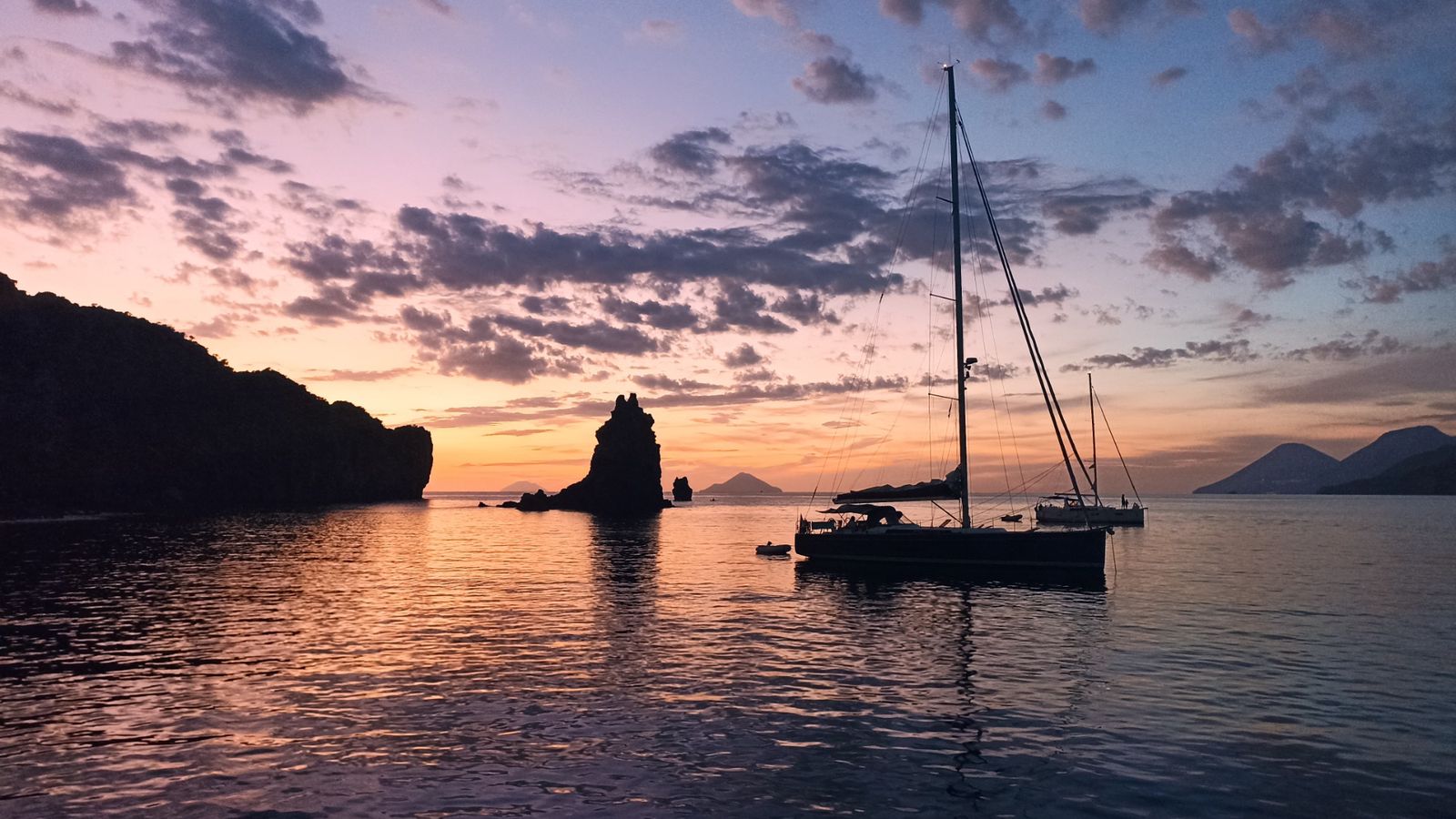
Getting There: Ferry Approach and Charter Bases
The vast majority of Aeolian charters depart from Milazzo on Sicily's north coast, the main ferry port connecting the mainland to the archipelago. Milazzo is approximately 45 minutes by car from Messina and 90 minutes from Catania's Falcone-Borsellino Airport (Palermo also works if you're arriving from the west). Several charter companies operate directly from Milazzo's marina, making the logistical setup straightforward — fly in, collect provisions, and sail the following morning.
It's also possible to begin or end a charter at Lipari, the largest island, which has ferry connections to Milazzo and Palermo. This is useful for one-way itineraries, though it adds a ferry transfer and limits provisioning flexibility compared to starting in Milazzo.
For sailors arriving by their own boat from Sardinia or mainland Italy, the most common approach is from Palermo (roughly 80 nautical miles southwest) or from Tropea on Calabria's Tyrrhenian coast (about 45 nautical miles northeast). A direct overnight crossing from Naples is feasible in settled conditions and delivers you to the islands at dawn — one of the great Mediterranean sail-in experiences.
Suggested 7-Day Aeolian Islands Itinerary
The following itinerary assumes a charter departure from Milazzo on Saturday morning and a return the following Friday or Saturday. It covers all seven islands with flexibility built in for weather, and can be adapted to a 5-day schedule by skipping Filicudi and Alicudi or by spending two nights at a single island.
Day 1: Milazzo to Vulcano (11 NM)
Depart Milazzo in the morning and make for Vulcano — the closest island and a logical shakedown sail. The passage crosses the narrow strait between Sicily and the Aeolians and can be lively in a moderate Tramontane. Porto di Levante, Vulcano's main port, has a small marina and mooring buoys, but the real attraction is Porto di Ponente on the west side — a striking black-sand beach bay where you can anchor in 5–8 meters over sand.
Spend the afternoon at the famous fanghi (mud baths) near the crater fumaroles, a short walk from the port. The sulfurous mud is said to have therapeutic properties and is a compulsory Aeolian experience, though it will leave your swimwear permanently stained yellow. Take the crater hike in the late afternoon when the temperature drops — 391 meters of volcanic scramble rewarded with views of all seven islands on a clear day.
Day 2: Vulcano to Lipari (5 NM)
A short morning sail north to Lipari, the archipelago's capital and the best place to provision the boat for the week ahead. Lipari's main harbor, Marina Corta, is the atmospheric old port, while Marina Lunga handles charter yachts with full berthing facilities. The town itself is one of southern Italy's most beautiful — a baroque hilltop citadel surrounded by obsidian cliffs, excellent restaurants, and a genuinely good archaeological museum housing Aeolian artifacts spanning 6,000 years.
In the afternoon, motorsail or sail to the spectacular anchorage at Spiaggia Bianca (White Beach) on Lipari's northeast coast — a curve of pumice-white pebbles accessible only by sea, the water so clear it looks like gin. Anchor in 4–7 meters and swim ashore. Spend the night in Lipari town for dinner: the pasta alle melanzane and fresh-caught pesce spada (swordfish) are exceptional.
Day 3: Lipari to Panarea (17 NM)
This passage takes you northeast through the broad channel east of Salina. In a moderate Maestrale you'll have a fine beam reach for most of the crossing. Panarea is the smallest inhabited island in the archipelago and historically the most fashionable — it attracts a wealthy Italian summer crowd, and the village above the port is a maze of whitewashed houses with bougainvillea spilling over every wall.
The main mooring field is in Cala Zimmari on the east side, a beautiful bay with clear water and good holding in sand, though it can become uncomfortable in a northerly. The anchorage west of the port (near Punta del Corvo) is calmer in north winds. A short dinghy ride to the offshore stacks at Basiluzzo gives you some of the best snorkeling in the Aeolians — volcanic rock architecture, abundant fish, extraordinary visibility. Panarea's evening social scene centers on the harbor bars; don't plan an early night.
Day 4: Panarea to Stromboli (14 NM)
The day's passage to Stromboli should ideally be timed to arrive in the early afternoon, giving you time to explore the island before the main event: the eruption at night. Stromboli is the most dramatic of the seven islands by a considerable margin — a near-perfect volcanic cone erupting every 15–20 minutes, day and night, shooting incandescent lava bombs from its northwest crater vent (the Sciara del Fuoco, or slope of fire).
Anchor in the bay at San Bartolo on the northeast side of the island or pick up one of the mooring buoys. The holding is reasonable but the bay can roll in easterly swell. The village of Stromboli is a revelation — 400 residents, white cubic houses, the wonderful La Sirenetta and Punta Lena restaurants, and Ingrid Bergman's former house visible above the town (she and Roberto Rossellini famously sheltered here during the filming of Stromboli in 1950).
In the evening, anchor the boat in full view of the Sciara del Fuoco (several dedicated mooring buoys are positioned for this purpose) and watch the eruptions from the cockpit with a glass of Malvasia delle Lipari, the extraordinary amber dessert wine produced on Salina. This is one of the most extraordinary experiences in Mediterranean sailing.
Day 5: Stromboli to Filicudi (30 NM)
The longest passage of the week, heading southwest across open water toward the western outer islands. In a Maestrale this can be a brisk beat or close reach with some ocean swell running — this is the leg where seasickness medication earns its keep for susceptible crew members. Plan to depart early to arrive at Filicudi in the early afternoon.
Filicudi is the quieter, more rugged sibling of the outer islands. The main anchorage at Porto Filicudi is a small bay with a handful of mooring buoys, a basic marina quay, and two or three restaurants. The island has no banks, minimal internet, and a population of around 200 permanent residents. What it does have is spectacular prehistoric Bronze Age village remains at Capo Graziano, excellent diving at La Canna (a dramatic 70-meter offshore basalt stack), and a profound sense of remoteness that feels increasingly rare in the crowded Mediterranean.
Walk up to the village of Filicudi Porto in the evening — the sunset views back toward Salina and Lipari from the terraced hillside are exceptional, and the restaurant at Pensione La Canna serves some of the freshest seafood in the islands.
Day 6: Filicudi to Alicudi, then to Salina (10 + 22 NM)
A morning detour west to Alicudi — the remotest and most unspoiled of the seven — before heading east to Salina for the final night. Alicudi has no roads, no cars, and no mains electricity (a generator was finally installed in the 1990s). The 100 or so year-round residents still use donkeys to carry goods up the stepped stone paths that wind around the island's single volcanic peak. It's one of the most genuinely isolated communities in the European Union.
There's no proper harbor at Alicudi — just a small concrete quay and a handful of mooring buoys in the bay. In settled conditions, anchor in 5–10 meters off the western shore. Have a coffee at the single bar, walk the stepped paths above the village, and then depart by midday for the longer sail to Salina.
Salina is the greenest and arguably the most beautiful of the Aeolians, its twin volcanic peaks (Monte Fossa and Monte dei Porri) covered in capers, Malvasia vines, and maquis. The island is most famous as the filming location for the 1994 film Il Postino. Anchor or take a buoy at Santa Marina Salina or Rinella on the south coast, and spend the evening at one of the excellent restaurants in the village. The capers of Salina are protected by a DOC designation — buy a jar before you leave.
Day 7: Salina to Milazzo (23 NM)
A morning departure from Salina southwest toward Milazzo, a comfortable 4–5 hour sail in typical Maestrale conditions. If time permits, stop for a final swim at Capo Milazzo — a narrow promontory with beautiful clear water just north of the marina — before returning the boat. Budget time for the checkout handover and a final dinner in Milazzo before traveling onward.
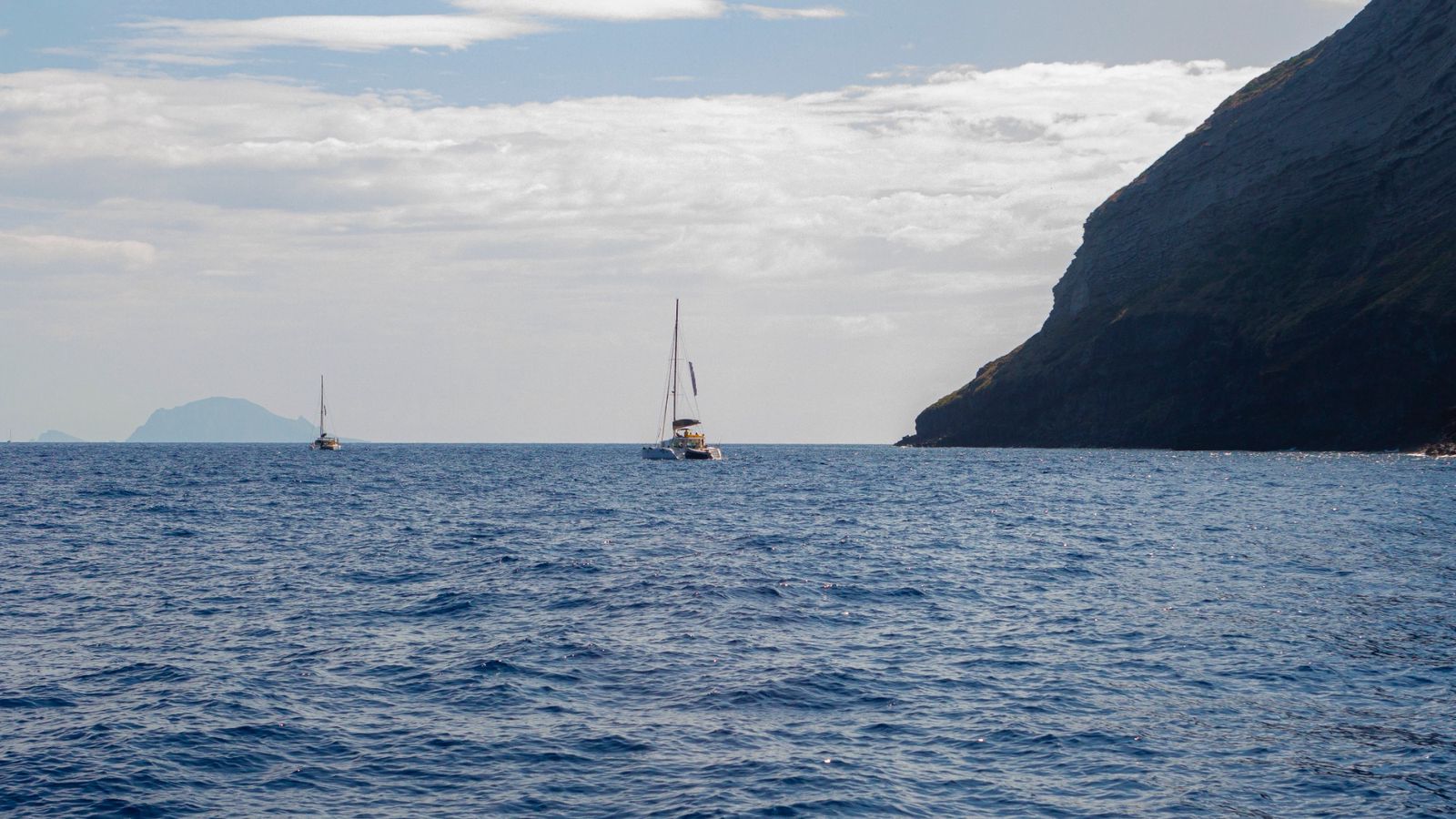
Key Stops: Anchorages and Moorings in Detail
Vulcano: Porto di Ponente
The black sand bay on the western side of Vulcano is the most photogenic anchorage in the southern Aeolians. Anchor in 5–8 meters over dark volcanic sand and take the dinghy ashore to a beach fringed with steam vents. Note: the bay is exposed to westerly swell and should be vacated if the Libeccio (southwest wind) builds.
Lipari: Spiaggia Bianca
The White Beach anchorage on Lipari's northeast coast is one of the Aeolians' best-kept open secrets. Accessible only by sea, the pumice beach is stunning and the snorkeling offshore is excellent. Hold in 4–6 meters over sand and pumice. Exposed to northeast swell — check the forecast before committing to an overnight here.
Panarea: Cala Zimmari
The main anchorage on Panarea's east coast, this bay has good holding in 4–10 meters over sand and is the social hub of the island's mooring scene. Gets very busy in August. The offshore islets and stacks (Basiluzzo, Dattilo, Lisca Bianca) visible from the anchorage are extraordinary snorkeling territory.
Stromboli: Ficogrande / San Bartolo Bay
The primary anchorage at Stromboli is off the black-sand beach at Ficogrande, northeast of the port. Mooring buoys are available from local operators. The bay rolls in any easterly component — some skippers prefer the small mooring field on the southwest side, protected by the island mass but further from the village. Either way, the proximity to the Sciara del Fuoco and the night eruption views make this the most memorable overnight of any Aeolian itinerary.
Salina: Rinella
The southern bay of Rinella is quieter than Santa Marina and better protected in Maestrale conditions. A small fishing harbor with limited berths on the quay and anchorage space in the bay — 4–8 meters over sand. The village above has a good trattoria and a weekly ferry connection to Lipari. A lovely, unhurried final night anchorage.
Mooring and Marina Practical Notes
The Aeolian Islands are not a marina-heavy destination. Fully serviced marinas with reliable shore power and water exist only at Lipari (Marina Lunga) and, to a lesser extent, at the Porto di Levante on Vulcano. At Panarea, Stromboli, Filicudi, and Alicudi, you will anchor or take a local mooring buoy — your preparation matters.
Mooring buoys throughout the archipelago are operated by local fishermen and cooperatives. Expect to pay EUR 15–30 per night for a buoy, depending on boat size and season. The buoys are generally reliable but should be inspected visually on arrival. Keep a snorkel and mask on the transom so you can check the bridle underwater if you're in any doubt about the setup.
Anchoring is still possible and legal at most anchorages in the Aeolians (unlike some other Mediterranean marine protected areas), but there are anchor restrictions in certain posidonia grass zones. The golden rule is to anchor only over sand or volcanic rubble, never on posidonia. With the Aeolians' extraordinary visibility, identifying the seabed type before dropping the hook is usually straightforward.
Fuel is available at Lipari and Vulcano. Carry enough reserves to reach Lipari from any point in the archipelago without stress — the outer islands (Filicudi, Alicudi) have no fuel.
Cost Expectations
The Aeolians are a premium charter destination by Italian standards, but still represent excellent value compared to the French Riviera, Croatia's high season, or the Greek island hotspots.
A bareboat charter of a well-equipped 40–44 foot monohull from Milazzo will typically cost EUR 2,500–4,500 per week in the shoulder season (May/June, September/October) and EUR 4,500–7,000 per week in peak July and August. Catamarans and larger vessels command a significant premium. Many charter companies require a flotilla or skipper if you cannot demonstrate sufficient offshore experience.
On-board costs are moderate. Provisioning from Lipari's supermarkets is comparable to mainland Italy prices. Mooring buoys add EUR 100–200 for the week. Diesel consumption depends on motoring versus sailing, but budget EUR 150–250 for fuel. Eating ashore at Stromboli or Panarea's restaurants — both islands have some of the highest prices in the archipelago due to the logistics of supplying a remote island — expect to pay EUR 35–55 per head for a full dinner with wine.
The single biggest optional expense is the guided crater hike on Stromboli. The climb to the observatory viewpoint is free, but access to the 400-meter crater rim requires a licensed guide and costs EUR 30–40 per person. It is absolutely worth doing if your schedule and fitness allow — the views of the active crater from above are something that photographs simply cannot capture.
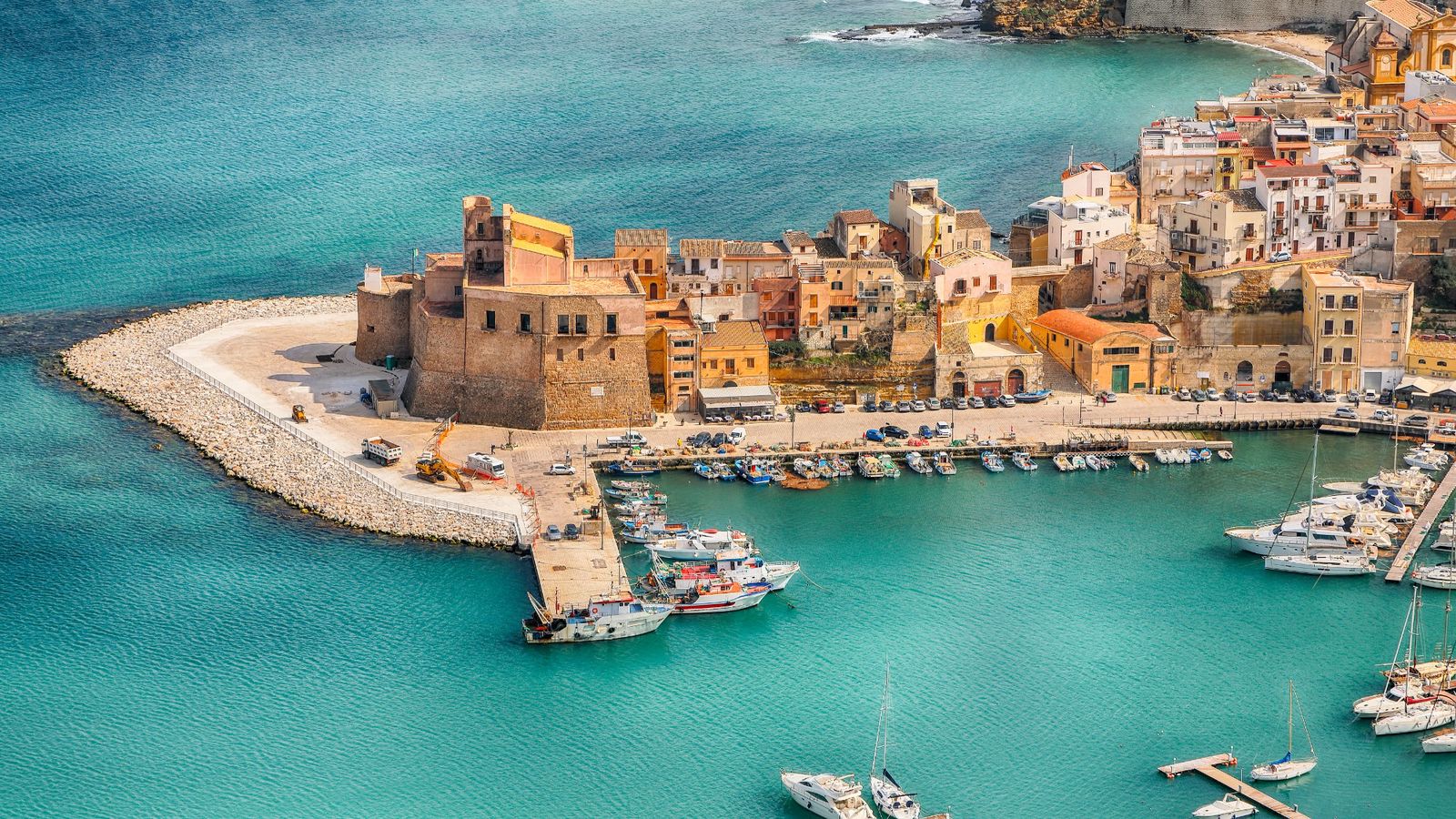
Three Insider Tips for the Aeolians
Tip 1: Time Your Stromboli Approach for Dusk
The eruptions at Stromboli are continuous but only spectacular at night, when you can see the incandescent lava against the darkness. If you arrive in the morning, you'll have a full day ashore — a good thing — but the dramatic visual impact of the Sciara del Fuoco is lost in daylight. Aim to anchor off Stromboli so you're settled on your mooring before sundown, with a clear sightline to the northwest crater. Pour the Malvasia. Do not rush this moment.
Tip 2: Carry a Jerrycan for the Outer Islands
Filicudi and Alicudi have no fuel facilities whatsoever. If you're sailing an itinerary that includes both outer islands and you've done a lot of motoring to get there (common in the light conditions that sometimes prevail in September), you don't want to be anxiously calculating reserves on the return leg to Lipari. A single 20-liter jerrycan carried on deck from Lipari solves the problem entirely and costs you almost nothing.
Tip 3: Book the Strombolicchio Swim at Slack Tide
Strombolicchio is the extraordinary basalt pinnacle that rises from the sea about 1.5 nautical miles northeast of Stromboli — a 50-meter near-vertical plug of ancient volcanic rock with a lighthouse on top and a near-vertical staircase cut into the cliff. The snorkeling around its base is outstanding, with schools of amberjack, bream, and moray eels in the volcanic rock channels. But the current can run strongly around the pinnacle at half tide. Plan your swim for the slack-water period (check local tide tables) and you'll have the water nearly to yourself and no current fighting your dinghy anchor.
Final Thoughts
The Aeolian Islands reward sailors who come prepared and leave with time to spare. The temptation — particularly on a 7-day charter — is to cram in every island, every anchorage, every hike. Resist it. The best Aeolian sailing weeks are the ones where you decide on Day 3 to spend an extra half-day at Filicudi because the water is perfect and the caponata at the harbourside restaurant was the best you've ever eaten.
The islands are small. The passages are short. The volcanic drama is extraordinary, but so is the quieter texture of life in these remarkable places — the capers drying on stone terraces, the old men playing scopa in the shade of a harbor bar, the absolute, enveloping silence of an Alicudi anchorage at three in the morning with the Milky Way overhead and the faint sulfur smell of Vulcano drifting on the warm air from the southeast.
Come in June or September. Bring snorkeling gear, a good Malvasia, and enough anchor chain. The rest takes care of itself.
Frequently asked questions
What is the best time of year to sail the Aeolian Islands?
The best time to sail the Aeolian Islands is late May to mid-June or the first three weeks of September. These shoulder periods offer warm, settled Maestrale sailing conditions, sea temperatures of 20–24°C, and significantly less crowded anchorages than July and August. Peak season brings reliable weather but full mooring buoys by midday at Panarea and Stromboli, higher charter prices, and a much busier atmosphere, especially on Panarea.
Where do you base a sailing charter for the Aeolian Islands?
Most Aeolian charters depart from Milazzo on Sicily's north coast, which is the main ferry hub for the archipelago. Milazzo is roughly 45 minutes by car from Messina and 90 minutes from Catania Airport. It is also possible to charter from Lipari directly or to approach by private boat from Palermo (about 80 nautical miles), Tropea in Calabria (about 45 nautical miles), or even Naples on an overnight passage.
How difficult is it to sail the Aeolian Islands — is it suitable for beginners?
Sailing the Aeolian Islands is best suited to skippers with offshore experience — at minimum, RYA Day Skipper level or equivalent with experience handling 20–25 knot conditions at sea. The inter-island passages are short (10–20 nautical miles), but anchorages can be rolly in northerly swell and several islands have no protected marinas. Beginners with a professional skipper aboard will find the Aeolians very manageable and rewarding.
Where do you anchor or moor at Stromboli?
At Stromboli, you anchor off the black sand beach at Ficogrande or take one of the local mooring buoys in San Bartolo Bay, northeast of the port. Mooring buoys cost approximately EUR 15–30 per night depending on boat size and season, and are operated by local fishermen. The bay can roll in easterly swell, so some skippers prefer the small alternative mooring field on the southwest side of the island. There is no proper marina at Stromboli.
How much does it cost to charter a sailing yacht in the Aeolian Islands?
A 7-day bareboat charter on a 40–44 foot monohull costs approximately EUR 2,500–4,500 per week in shoulder season (May/June and September/October) and EUR 4,500–7,000 in peak July and August. On top of the charter fee, budget around EUR 100–200 for mooring buoys across the week, EUR 150–250 for fuel, and EUR 35–55 per person for a restaurant dinner on the more expensive islands like Stromboli and Panarea.
Are there marinas and mooring buoys in the Aeolian Islands, and where can you get fuel?
Mooring buoys are available at all the main anchorages, including Vulcano, Panarea, Stromboli, Filicudi, and Alicudi. They cost EUR 15–30 per night. Fully serviced marinas exist only at Lipari (Marina Lunga) and partially at Vulcano (Porto di Levante). Anchoring is permitted at most locations but should only be done over sand or volcanic rubble — not over posidonia seagrass meadows, which are a protected habitat. Fuel is only available at Lipari and Vulcano, so plan accordingly if visiting the outer western islands.


